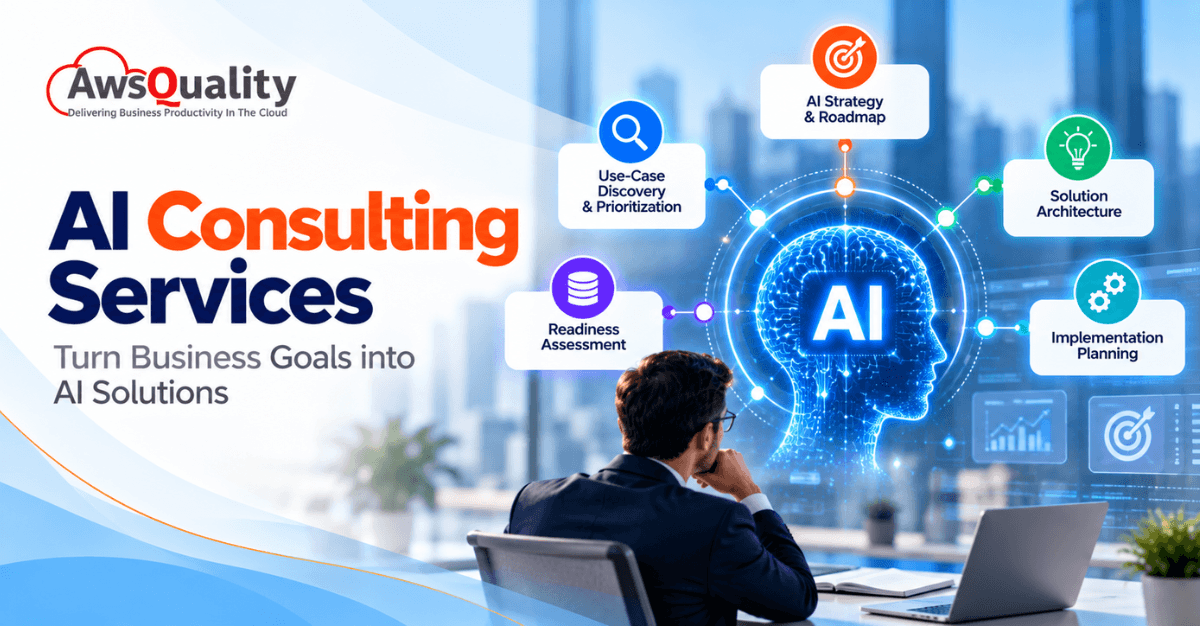
AI Consulting Services to Turn Business Goals into AI Solutions
Make informed decisions about artificial intelligence with AwsQuality’s AI consulting services. We help businesses identify valuable AI opportunities, evaluate technical feasibility, assess data readiness, and develop practical strategies for adopting AI in their operations.
Whether you’re exploring generative AI, considering AI agents, looking to automate business processes, or planning to integrate AI into existing applications, we help you understand your options and determine the right path forward. Our approach connects business objectives with technology choices, implementation requirements, and measurable success criteria.
From initial AI assessments and use-case prioritization to solution architecture and implementation planning, our artificial intelligence consulting services help you move beyond experimentation toward a clear, business-focused AI roadmap.
Not sure where AI can create value for your business? Let’s discuss your goals, challenges, and potential opportunities.
What are AI Consulting Services?
AI consulting services help businesses identify where artificial intelligence can create value, evaluate the feasibility of potential solutions, and plan how to adopt AI effectively. These services can include AI strategy, readiness assessments, use-case prioritization, technology selection, solution architecture, data planning, and AI governance.
The goal is to help organizations make informed decisions before and during implementation. Depending on the project, AI consulting can produce a prioritized roadmap, technical recommendations, feasibility findings, and a practical plan for developing and integrating AI solutions.
AI Consulting Services for Your Business
Every business has different priorities, technology systems, data resources, and operational challenges. An AI initiative that works for one organization may not be suitable for another.
Our AI consulting services help you evaluate these differences before committing to a particular technology or implementation. We work with you to understand your business objectives, assess potential solutions, and identify the steps needed to move forward.
AI Strategy and Roadmap Development
A successful AI initiative starts with a clear understanding of what your business wants to achieve. Without a strategy, organizations can invest in disconnected experiments that are difficult to scale or evaluate.
Our AI strategy consulting helps you identify potential applications of AI, align opportunities with business priorities, and develop a roadmap for implementation.
We consider your current processes, technology environment, available data, business objectives, and operational constraints when evaluating potential initiatives.
Our AI strategy services can include:
- Identifying opportunities to apply AI across business functions
- Aligning AI initiatives with organizational goals
- Prioritizing potential use cases based on value, feasibility, and risk
- Evaluating technology and implementation options
- Identifying data, infrastructure, and integration requirements
- Developing a phased AI adoption roadmap
- Defining metrics for evaluating business outcomes
The result is a practical direction for your AI initiatives, with clear priorities and recommended next steps.
AI Readiness Assessment
Before investing in an AI solution, it is important to understand whether your organization has the data, infrastructure, processes, and capabilities needed to support it.
Our AI readiness assessment helps identify the gaps that may affect implementation, adoption, and long-term maintenance.
We examine your current technology environment and the requirements of your proposed use cases to understand what is ready, what needs improvement, and where additional planning may be necessary.
An AI readiness assessment may cover:
- Data availability, quality, accessibility, and sensitivity
- Existing applications and system architecture
- Cloud infrastructure and computing requirements
- Data integration and processing needs
- Security, privacy, and governance considerations
- Team capabilities and adoption requirements
- Potential technical and operational risks
Based on the findings, we can help establish a prioritized plan for addressing readiness gaps before moving into development.
AI Use-Case Discovery and Prioritization
Not every business problem requires artificial intelligence. The goal is to identify situations where AI offers a practical advantage over existing software, business rules, or manual processes.
Our AI consulting approach helps you identify and compare potential use cases before making an investment.
We consider factors such as expected business value, implementation complexity, data readiness, integration effort, operating cost, and the consequences of an incorrect AI output.
Potential use cases include:
- Automating repetitive document-processing tasks
- Improving access to internal business knowledge
- Assisting customer service teams with information retrieval
- Analyzing business data to support planning and forecasting
- Integrating AI capabilities into CRM and enterprise applications
- Streamlining internal workflows with AI assistants or agents
- Improving search, classification, and information extraction
We help you distinguish promising opportunities from ideas that may require more data, more preparation, or a different technical approach.
Generative AI and LLM Consulting
Generative AI can support a range of business applications, but choosing a model is only one part of a successful implementation. Businesses also need to consider data access, response quality, integration, security, operating costs, and ongoing evaluation.
Our generative AI consulting services help you assess where large language models (LLMs) may be useful and how they could fit into your existing applications and workflows.
We can help evaluate approaches for AI assistants, enterprise knowledge search, document analysis, conversational applications, and other language-based use cases.
Our consulting scope may include:
- Identifying suitable generative AI use cases
- Evaluating model and API options
- Planning retrieval-augmented generation (RAG) architectures
- Assessing prompt design and output evaluation requirements
- Planning integrations with internal data and business systems
- Evaluating latency, usage costs, and scalability
- Defining testing, monitoring, and human-review requirements
The recommended approach depends on your business objectives, data, and the level of reliability required for the intended application.
AI Agent Consulting
AI agents can use approved tools, access relevant information, and coordinate multiple steps within a defined workflow. However, the level of autonomy should reflect the task, business risk, and available controls.
Our AI agent consulting helps businesses identify where agent-based approaches may be appropriate and how to plan their architecture, permissions, integrations, and oversight.
We evaluate whether an agent, a simpler automation workflow, or a conventional application would be the most suitable solution.
AI agent consulting can address:
- Identifying workflows that may benefit from agent-based automation
- Defining agent responsibilities and task boundaries
- Evaluating tools, APIs, and enterprise system integrations
- Planning access permissions and data retrieval
- Establishing human approval and escalation points
- Evaluating reliability, failure handling, and performance
- Defining monitoring and evaluation requirements
The objective is to develop a clear implementation approach that balances automation opportunities with appropriate control and accountability.
AI Architecture and Technology Consulting
The architecture behind an AI solution affects its performance, integration, scalability, maintenance, and operating cost. Selecting technologies before understanding these requirements can create avoidable complexity.
Our AI architecture consulting helps you evaluate suitable technical approaches based on the intended use case and your existing systems.
Depending on your requirements, this may involve reviewing model providers, APIs, application frameworks, data pipelines, retrieval systems, databases, cloud infrastructure, and integration methods.
Our architecture consulting can help you:
- Compare potential AI solution architectures
- Evaluate build-versus-buy options
- Plan integration with existing applications and APIs
- Assess data processing and retrieval requirements
- Consider deployment and infrastructure options
- Evaluate scalability, latency, and operating costs
- Plan for testing, monitoring, maintenance, and future changes
The outcome is an architecture direction that supports your business needs without introducing unnecessary technology or complexity.
AI Data Strategy and Integration Planning
AI solutions depend on access to relevant, reliable, and appropriately governed information. Data that is fragmented, outdated, inconsistent, or difficult to access can limit the value of an otherwise suitable AI application.
Our AI data consulting helps you evaluate the information and integration requirements associated with your proposed use cases.
We can help identify data gaps, review existing data flows, and define how relevant information could be prepared and connected to AI applications.
This may involve planning data pipelines, API integrations, retrieval systems, cloud data platforms, and connections to enterprise applications.
Where additional data engineering is required, the recommendations can help establish the technical work needed before or alongside AI development.
AI Governance, Security, and Risk Consulting
AI initiatives can introduce questions about data privacy, access permissions, inaccurate outputs, accountability, and the appropriate level of automation. These considerations should be addressed before a solution is deployed.
Our AI consulting approach can help identify relevant risks and define requirements for responsible implementation.
Depending on the project, this may include:
- Identifying sensitive data and access requirements
- Defining roles, permissions, and approval processes
- Evaluating output accuracy and reliability
- Establishing human oversight for consequential decisions
- Considering auditability and monitoring requirements
- Identifying applicable organizational and regulatory obligations
- Planning controls for AI applications and connected systems
Requirements vary by industry, jurisdiction, and application. Specific regulatory compliance must be assessed against the applicable obligations rather than assumed from the use of a particular technology.
AI Proof of Concept and Feasibility Consulting
When the feasibility of an AI use case is uncertain, a proof of concept (PoC) can help test key assumptions before committing to a larger implementation.
Our AI feasibility consulting helps define what needs to be validated, which data and technologies are required, and how success should be evaluated.
Depending on the scope, this may involve preparing a technical plan, defining an evaluation framework, assessing a proposed model, or working with development teams on a limited prototype.
A PoC can help answer practical questions:
- Can the proposed approach address the business problem?
- Is the available data suitable for the intended task?
- How accurate and consistent are the results?
- Can the solution integrate with existing systems?
- What are the expected operating costs and limitations?
- What would be required to move toward production?
The findings provide a basis for deciding whether to proceed, refine the use case, explore another approach, or use an existing commercial solution.
Our AI Consulting Process
Our process is designed to help businesses move from an initial idea to a clear, actionable implementation plan.
Step 1: Understand Your Business Objectives
We begin by understanding your goals, operational challenges, existing workflows, target users, and expectations for AI.
This helps establish the business problem that the proposed initiative needs to solve.
Outcome: Defined objectives, initial requirements, and candidate use cases.
Step 2: Assess AI Readiness and Feasibility
We review the data, systems, infrastructure, and operational requirements relevant to the selected use cases. We also consider technical limitations, dependencies, and risks.
Outcome: An assessment of readiness, feasibility, and key gaps.
Step 3: Identify and Prioritize Opportunities
We compare candidate use cases based on their expected value, implementation effort, data readiness, risk, and alignment with business priorities.
Outcome: A prioritized set of opportunities and recommended next steps.
Step 4: Evaluate Technologies and Architecture
We assess appropriate models, APIs, frameworks, infrastructure, and integration approaches. The recommendations account for functional requirements, performance, maintainability, and operating cost.
Outcome: A proposed technical direction and architecture recommendations.
Step 5: Develop the AI Roadmap
We translate the findings into a phased plan that identifies the recommended sequence of work, key dependencies, resources, and success measures.
Outcome: An AI roadmap aligned with business goals and implementation requirements.
Step 6: Plan Validation and Implementation
Where appropriate, we define a proof of concept or implementation plan to validate key assumptions. We identify testing requirements, evaluation criteria, integration work, and deployment considerations.
Outcome: A practical path toward development and deployment.
Step 7: Measure and Refine
We define how the initiative should be evaluated against the original objectives. Depending on the engagement, this may include reviewing pilot results, refining the roadmap, and identifying opportunities for further improvement.
Outcome: A basis for evaluating progress and deciding on the next stage of AI adoption.
The scope of an engagement can vary. Some businesses need a focused feasibility assessment, while others require a broader strategy and architecture engagement.
What You Can Expect from an AI Consulting Engagement
The deliverables depend on your objectives and the scope of work. A consulting engagement may produce some or all of the following:
- AI readiness findings: An overview of relevant data, systems, capabilities, and gaps.
- Use-case assessment: A comparison of candidate AI opportunities based on value, feasibility, and risk.
- Technology recommendations: An assessment of suitable models, platforms, APIs, and implementation approaches.
- Solution architecture guidance: Recommendations for application design, data access, integrations, and infrastructure.
- AI adoption roadmap: A prioritized sequence of recommended initiatives and implementation steps.
- Evaluation criteria: Proposed metrics for assessing technical performance and business outcomes.
- Risk and governance considerations: Identified risks and recommended controls relevant to the proposed use case.
- Implementation plan: Recommended next steps for prototyping, development, integration, and deployment.
The final deliverables are agreed according to the business requirements, available information, and engagement scope.
How AI Consulting Connects with AI Development
AI consulting and AI development serve different but complementary purposes.
AI consulting helps establish what should be built, why it is needed, whether it is feasible, and how the work should be approached. AI development focuses on engineering the application, model-related components, integrations, and workflows required to implement the solution.
For some businesses, consulting is the right starting point because the use case or technical direction is still unclear. Others may already have a defined requirement and be ready to begin development.
AwsQuality offers both consulting and development capabilities, allowing the next steps to be planned around your project’s needs.
Need help implementing a defined AI use case?
Explore our AI Development Services to learn more about building custom AI applications, generative AI solutions, integrations, and intelligent automation.
Why Choose AwsQuality for AI Consulting Services?
Business Goals Before Technology Choices
We begin by understanding the business problem, intended outcomes, and constraints before recommending an AI approach. This helps prioritize opportunities based on relevance and feasibility.
Consulting Informed by Engineering
Our broader technology capabilities across AI, data engineering, cloud, and application development help inform discussions about data readiness, architecture, integration, and implementation requirements.
Enterprise Integration Perspective
AI solutions often need to work with existing CRM platforms, business applications, APIs, and data systems. We consider these dependencies when evaluating potential solutions and planning the next steps.
A Practical Path from Assessment to Implementation
We help define priorities, assess feasibility, and outline the work required to move forward. When development is appropriate, our AI development capabilities can support the transition from planning to implementation.
Our AI Consulting Services for The Different Industries
The right AI consulting approach depends on the processes, information, and constraints within each industry. Potential areas for evaluation include:
Healthcare
Assess opportunities for administrative automation, document processing, internal knowledge access, and operational planning. Clinical applications require appropriate validation, privacy safeguards, and qualified oversight.
Financial Services
Evaluate AI use cases involving document analysis, customer support, anomaly detection, forecasting, and internal knowledge retrieval. Risk-sensitive applications require careful validation and controls.
Retail and E-commerce
Explore recommendation systems, customer service assistance, demand forecasting, inventory planning, and customer experience improvements.
Manufacturing
Assess potential applications for visual quality inspection, predictive maintenance, production planning, and operational data analysis.
Logistics and Supply Chain
Explore forecasting, inventory analysis, shipment information processing, and workflow automation.
Technology and SaaS
Evaluate how AI can be incorporated into software products, internal tools, customer support workflows, and enterprise applications.
Professional and Business Services
Identify opportunities for document processing, research assistance, knowledge management, and repeatable administrative tasks.
These examples illustrate potential use cases rather than a claim of prior project delivery in every industry. Suitability depends on each organization’s requirements and available data.
Frequently Asked Questions
What are AI consulting services?
AI consulting services help businesses identify opportunities for artificial intelligence, evaluate technical feasibility, assess data readiness, select suitable technologies, and plan implementation. They can include AI strategy, use-case prioritization, architecture guidance, generative AI consulting, governance considerations, and implementation planning.
What do artificial intelligence consulting services include?
Artificial intelligence consulting services can include AI readiness assessments, business use-case discovery, strategy and roadmap development, data and integration planning, model selection, solution architecture, feasibility assessments, and recommendations for responsible implementation. The scope depends on the organization’s goals and requirements.
Why should a business hire an AI consulting company?
An AI consulting company can help businesses evaluate potential use cases, understand technical requirements, compare solution options, and identify risks before committing to development. Consulting can be particularly useful when the organization needs help deciding where AI can create value or how to approach a complex implementation.
What is the difference between AI consulting and AI development?
AI consulting focuses on planning, feasibility, strategy, technology selection, and architecture recommendations. AI development focuses on building, testing, deploying, and integrating the solution. A project may require consulting first, development directly, or a combination of both.
How do I know if my business is ready for AI?
Readiness depends on the use case. Important considerations include data quality and accessibility, existing systems, security requirements, infrastructure, internal capabilities, and a clear business objective. An AI readiness assessment can help identify gaps and establish the steps needed before implementation.
How much do AI consulting services cost?
Costs depend on the engagement scope, number and complexity of use cases, data and system requirements, technical depth, and expected deliverables. A focused feasibility assessment will generally require a different level of effort than a broader AI strategy and architecture engagement. A project estimate can be developed after the requirements are understood.
How long does an AI consulting engagement take?
The timeline depends on the scope, availability of information, complexity of the business requirements, and number of use cases being assessed. A focused assessment may be completed more quickly than a multi-system enterprise strategy engagement. A realistic timeline should be established during initial scoping.
Can AI consulting help us choose the right AI model?
Yes. Model selection can consider the intended task, output quality, latency, privacy, integration options, scalability, and operating cost. Depending on the application, the most suitable approach may involve a commercial model API, an open-source model, a traditional machine learning method, or a combination of technologies.
Can AI consulting help us integrate AI into existing applications?
Yes. Consulting can help identify integration options and define requirements for connecting AI capabilities to existing applications, APIs, databases, and business workflows. The feasibility depends on the current architecture, available interfaces, data access, and security constraints.
Does AI consulting include implementation?
It can, depending on the engagement. Some projects focus on strategy and planning, while others progress into prototyping, development, integration, and deployment. The scope and responsibilities should be agreed before work begins.
How do you measure the success of an AI initiative?
Success should be evaluated against the intended business outcome. Depending on the use case, relevant measures may include processing time, task completion, output quality, manual effort, adoption, cost per task, or forecast accuracy. Establishing a baseline before implementation helps make the results easier to evaluate.
Let’s Define the Right AI Strategy for Your Business
You do not need to have every technical decision made before exploring AI. Start with the challenge you want to address, the outcome you want to achieve, and the information or systems involved.
AwsQuality can help you evaluate potential AI opportunities, understand the requirements, and plan a practical path toward implementation.