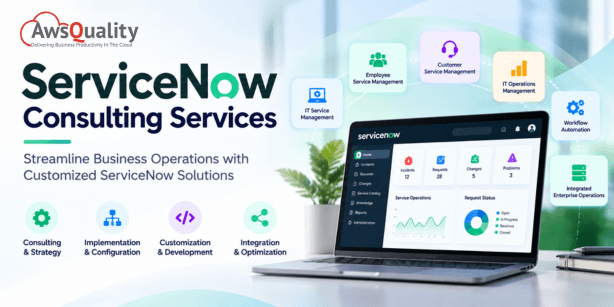
Streamline Business Operations with Customized ServiceNow Solutions
Transform the way your business manages IT services, workflows, and enterprise operations with ServiceNow consulting services from AwsQuality. We help organizations evaluate their requirements, implement ServiceNow solutions, integrate business systems, and automate workflows to support more efficient operations.
Whether you are implementing ServiceNow for the first time, modernizing an existing platform, or looking for ongoing technical support, our approach focuses on your business goals, operational requirements, and long-term platform needs.
From consulting and implementation to customization, integration, and optimization, AwsQuality helps you plan a ServiceNow solution that aligns with your organization’s processes.
Looking for a ServiceNow consultant for your next project?
What are ServiceNow Consulting Services?
ServiceNow consulting services help businesses plan, implement, customize, integrate, and optimize the ServiceNow platform to improve workflows and manage enterprise operations.
ServiceNow provides cloud-based workflow capabilities that connect people, processes, and systems across different business functions. Organizations can use the platform to manage IT service requests, track incidents, automate employee services, coordinate customer support, and improve operational visibility.
A ServiceNow consulting company helps determine how these capabilities can support your specific requirements. This may involve assessing existing processes, selecting suitable platform applications, configuring workflows, integrating external systems, and establishing processes for ongoing maintenance.
The goal is not simply to implement another software platform. It is to create a connected operating environment that helps employees complete tasks, gives teams better visibility, and supports consistent service delivery.
Our ServiceNow Consulting Services
AwsQuality helps businesses evaluate ServiceNow opportunities and plan technology solutions around their operational requirements. Our consulting and development approach considers business processes, existing applications, integration needs, and long-term platform management.
1. ServiceNow Consulting and Strategy
A successful ServiceNow initiative starts with understanding your current challenges and desired outcomes. Implementing technology without first evaluating business processes can lead to unnecessary customization, complicated workflows, and limited adoption.
Our ServiceNow consulting approach begins with assessing your requirements and identifying where the platform can deliver practical value.
Our consulting services can include:
- Business process assessment and workflow analysis
- ServiceNow readiness and requirements assessment
- Platform application and module evaluation
- Current-state and future-state process mapping
- Workflow automation opportunities
- Technical feasibility and integration assessment
- Implementation roadmap and project planning
- Success metrics and adoption planning
We help you prioritize opportunities based on business value, implementation complexity, operational requirements, and available resources.
The outcome: A clear implementation direction that connects ServiceNow capabilities with your business priorities.
2. ServiceNow Implementation Services
Implementing ServiceNow requires careful planning, appropriate configuration, process alignment, and thorough testing. The implementation approach should reflect your organization’s workflows rather than simply reproduce existing processes in a new system.
AwsQuality can help scope and plan ServiceNow implementation projects based on your requirements, existing systems, and target outcomes.
Implementation activities may include:
- Requirements gathering and process discovery
- Platform configuration and workflow setup
- Application and module implementation planning
- Service catalog and request workflow configuration
- Roles, permissions, and access considerations
- Integration planning and implementation
- Testing and validation
- Deployment preparation and documentation
- User enablement and post-launch support planning
We focus on defining clear requirements, deliverables, and acceptance criteria before moving into implementation.
This helps establish realistic expectations, manage scope, and ensure the solution is evaluated against agreed business and technical requirements.
3. ServiceNow Customization and Development
Every organization has processes that differ from standard operating procedures. ServiceNow configuration and development capabilities can help accommodate these requirements while maintaining a manageable platform architecture.
Our ServiceNow customization and development services can address requirements that cannot be met adequately through standard configuration alone.
Depending on the project, activities may include:
- Custom forms, fields, and business rules
- Workflow and approval customization
- Service catalog item development
- Portal and user experience improvements
- Scripted automation and platform logic
- Application development using suitable platform capabilities
- Custom integrations and reusable components
- Configuration reviews and technical documentation
Our approach is to evaluate standard platform capabilities first and introduce custom development where it provides clear value.
This helps avoid unnecessary complexity and supports easier maintenance as business requirements evolve.
4. ServiceNow Integration Services
ServiceNow becomes more valuable when it can exchange information with the systems your teams already use. Disconnected applications can create duplicate work, inconsistent records, and delays in completing business processes.
Our ServiceNow integration services help businesses plan and connect the platform with relevant enterprise applications and data sources.
Integration requirements may include:- CRM and customer management systems
- ERP and enterprise business applications
- Identity and access management systems
- Monitoring and IT operations tools
- HR and employee systems
- Databases and data platforms
- REST APIs and other supported interfaces
- Internal applications and third-party services
Depending on the architecture, integrations may use available APIs, supported connectors, IntegrationHub capabilities, or other suitable approaches.
Before implementation, we assess data ownership, authentication, permissions, synchronization requirements, error handling, and system dependencies.
The objective is to establish reliable information flows that support connected workflows without introducing unnecessary integration complexity.
5. ServiceNow Workflow Automation
Manual processes can slow service delivery, create inconsistent results, and make it difficult to track responsibilities. ServiceNow workflow automation can help standardize recurring tasks and coordinate activities across teams.
Our consulting approach identifies suitable automation opportunities and evaluates how they can be implemented using the platform’s available workflow capabilities.
Potential automation areas include:
- IT service request approvals
- Incident assignment and routing
- Employee onboarding and offboarding tasks
- Repetitive administrative workflows
- Service request fulfillment
- Notifications and task escalation
- Cross-department process coordination
- Status tracking and operational reporting
Automation rules should be designed around clear business requirements, appropriate permissions, and exception-handling procedures.
We help businesses distinguish between processes that can be automated reliably and those that require human review or more complex decision-making.
6. ServiceNow Optimization and Performance Improvement
An existing ServiceNow environment may become harder to manage as workflows, integrations, customizations, and user requirements grow.
ServiceNow optimization helps businesses review their current implementation, identify unnecessary complexity, and determine which improvements should be prioritized.
Our optimization activities can include:
- Configuration and workflow reviews
- Assessment of existing customizations
- Integration and data flow reviews
- Identification of process bottlenecks
- Platform performance investigation
- Review of access controls and permissions
- Technical documentation improvements
- Upgrade and release readiness planning
- Recommendations for maintainability and usability
The objective is to help your organization maintain a platform that supports current business needs while remaining adaptable to future changes.
7. ServiceNow Support and Maintenance
ServiceNow environments require ongoing administration, issue resolution, testing, and improvements as business processes and platform capabilities evolve.
AwsQuality can help define a support and maintenance approach suited to your organization’s technical requirements and internal resources.
Depending on the engagement, support activities may include:
- Troubleshooting and issue resolution
- Configuration changes and enhancements
- Workflow and integration maintenance
- Regression testing after relevant changes
- Documentation and knowledge transfer
- Platform health and performance reviews
- Upgrade and release planning
- Ongoing development support
Support scope, response times, service levels, and responsibilities should be agreed upon before the engagement begins.
Whether you need help addressing specific technical issues or planning a longer-term improvement program, a structured support model can help keep your ServiceNow environment aligned with business needs.
ServiceNow Solutions for Different Business Functions
ServiceNow supports multiple enterprise workflows. The right combination of applications depends on your organization’s needs, licensing, existing systems, and implementation goals.
IT Service Management (ITSM)
IT teams need consistent processes for handling incidents, service requests, problems, and changes. ServiceNow IT Service Management can help centralize these activities and provide greater visibility into service delivery.
Our ITSM consulting scope may include:
- Incident management workflows
- Problem management processes
- Change management workflows
- Service catalog and request fulfillment
- Knowledge management
- Service-level agreement tracking
- Approval and escalation processes
- IT service reporting
Business objective: Improve the consistency and visibility of IT service delivery while reducing avoidable manual effort.
IT Operations Management (ITOM)
Organizations managing complex IT environments need visibility into infrastructure, dependencies, and operational events.
ServiceNow IT Operations Management capabilities can help connect operational information with service context, depending on the products and features implemented.
Potential consulting areas include:
- Infrastructure discovery planning
- Configuration Management Database (CMDB) considerations
- Service mapping requirements
- Event and alert management
- Cloud and infrastructure monitoring integration
- Operational workflow automation
- IT operations reporting
Business objective: Improve operational visibility and help teams investigate and manage IT issues more effectively.
HR Service Delivery (HRSD)
Employee-facing HR processes often involve recurring questions, document requests, approvals, and coordination between departments.
ServiceNow HR Service Delivery can help organize employee requests and standardize selected HR workflows.
Potential use cases include:
- Employee service request management
- HR case management
- Employee self-service
- Onboarding and offboarding workflows
- HR knowledge management
- Request routing and approvals
- Employee service reporting
Business objective: Create more consistent employee service experiences and reduce repetitive administrative tasks.
Customer Service Management (CSM)
Customer service teams need visibility into cases, customer information, service requests, and resolution progress.
ServiceNow Customer Service Management can help coordinate customer-facing service workflows and connect customer support processes with relevant operational teams.
Potential consulting areas include:
- Customer case management
- Case routing and assignment
- Service request workflows
- Customer self-service
- Knowledge management
- Escalation and approval processes
- Integration with CRM and other business systems
Business objective: Improve case visibility, streamline service processes, and support more consistent customer experiences.
Security Operations (SecOps)
Security teams need coordinated processes for investigating incidents, prioritizing vulnerabilities, and managing responses.
Where the relevant ServiceNow applications and licenses are available, consulting may include workflow assessment and integration planning for security operations processes.
Potential areas include:
- Security incident workflow coordination
- Vulnerability response process assessment
- Security information integration
- Task assignment and escalation
- Security workflow reporting
- Integration with existing security tools
Business objective: Support more structured security workflows and improve visibility into response activities.
The suitability of each solution depends on your business requirements, product entitlements, data sources, and technical environment.
Our ServiceNow Consulting and Implementation Process
A structured process helps ensure that ServiceNow projects are based on clear requirements and can be evaluated throughout delivery.
Step 1: Discovery and Requirements Assessment
We begin by understanding your operational challenges, existing technology environment, users, and business goals.
We identify current process gaps, dependencies, and opportunities to improve how work is managed.
Deliverable: Documented requirements, initial scope, and business priorities.
Step 2: Process Analysis and Solution Design
We map the desired workflows and evaluate the most appropriate ServiceNow capabilities for the identified requirements.
This stage considers configuration options, integrations, security, reporting, and the need for custom development.
Deliverable: Proposed solution design and implementation plan.
Step 3: Configuration, Development, and Integration
The implementation team configures the agreed workflows, develops necessary components, and connects the relevant systems.
Changes should be made in suitable development or test environments and managed through the agreed release process.
Deliverable: Configured solution ready for validation.
Step 4: Testing and Validation
We validate functionality, permissions, integrations, exception handling, and relevant performance requirements.
Testing should cover common workflows as well as scenarios involving incomplete data, failed integrations, and unexpected user actions.
Deliverable: Test results, issue tracking, and acceptance review.
Step 5: Deployment and Knowledge Transfer
The solution is prepared for release according to the deployment plan. Documentation, user enablement, operational responsibilities, and rollback considerations are addressed as required.
Deliverable: Deployment-ready solution and agreed operational documentation.
Step 6: Ongoing Support and Optimization
After deployment, the solution can be reviewed against agreed performance indicators and user feedback.
The team can prioritize enhancements, address issues, review integrations, and plan future changes.
Deliverable: An improvement plan aligned with operational requirements.
Project timelines depend on the scope, selected applications, integration complexity, data quality, customization requirements, and testing needs. A reliable estimate should follow a discovery and requirements assessment.
Why Choose AwsQuality as Your ServiceNow Consulting Company?
Choosing a ServiceNow consulting company involves more than evaluating technical skills. You need a team that understands your business requirements, works within your existing technology environment, and can help you plan for ongoing platform management.
AwsQuality brings broader technology consulting and development capabilities across cloud, AI, DevOps, data engineering, integration, and software development. These capabilities can be relevant to ServiceNow initiatives that involve connected applications, APIs, data flows, and enterprise workflows.
Business-Focused Consulting
We begin with the processes you want to improve and the outcomes you need to achieve. This helps keep the proposed solution aligned with business priorities rather than unnecessary technology changes.
Integration and Development Capabilities
ServiceNow initiatives may require connections with existing applications, databases, APIs, and cloud environments. Our broader technology services can support assessment and planning for these connected requirements.
Practical Implementation Planning
Clear scope, defined deliverables, testing, and acceptance criteria help establish realistic expectations and make project progress easier to evaluate.
Focus on Maintainability
A platform should remain manageable after launch. We consider documentation, customization decisions, integration dependencies, and support requirements as part of the overall solution approach.
Flexible Engagement Options
Your organization may need consulting, implementation assistance, custom development, integration support, or ongoing technical resources. The appropriate engagement can be defined around your project scope and delivery requirements.
Support for Long-Term Improvement
Business processes and technology requirements change over time. A structured support and enhancement plan helps keep your ServiceNow environment aligned with those changes.
Need help with a ServiceNow initiative? Discuss your requirements with AwsQuality to identify the appropriate consulting and development approach for your business.
How to Choose the Right ServiceNow Consultant
Selecting the right ServiceNow consultant can significantly influence the scope, maintainability, and long-term usefulness of your implementation.
Before engaging a consultant or consulting company, consider the following factors.
Relevant Platform Experience
Ask about experience with the ServiceNow applications and workflows relevant to your project. For example, an ITSM implementation has different requirements from an HR service delivery or security operations initiative.
Business Process Understanding
A good consultant should understand how your teams work and identify opportunities to simplify processes before translating them into platform configurations.
Integration Capabilities
Review the consultant’s approach to APIs, authentication, data synchronization, error handling, and integration testing if your project involves multiple systems.
Security and Access Management
Discuss role-based access, data visibility, permissions, audit requirements, and any applicable compliance obligations.
Transparent Scope and Deliverables
Ask for a clear description of project phases, deliverables, responsibilities, assumptions, acceptance criteria, and exclusions.
Post-Implementation Support
Confirm how issues, upgrades, enhancements, documentation, and knowledge transfer will be handled after deployment.
Verifiable Credentials and Experience
Where certifications, official partner status, or specific platform expertise are important to your project, request evidence and verify the claims. Do not rely solely on marketing statements.
The best ServiceNow consultant is one whose experience and delivery approach match your actual requirements.
ServiceNow Consulting vs. ServiceNow Implementation
ServiceNow consulting and implementation are related, but they serve different purposes.
| Area | ServiceNow consulting | ServiceNow implementation |
|---|---|---|
| Primary focus | Assessing requirements and defining the right approach | Configuring and deploying the agreed solution |
| Typical activities | Discovery, process analysis, feasibility, roadmap planning | Configuration, development, integration, testing, deployment |
| Main output | Recommendations, requirements, and solution design | A configured solution aligned with agreed requirements |
| When it is useful | When the business needs help deciding what to implement | When requirements and implementation scope are sufficiently defined |
| Relationship | Establishes direction and priorities | Converts the agreed direction into a working solution |
Some projects require consulting before implementation, while others need targeted assistance within an established ServiceNow environment.
For larger initiatives, combining both can help connect business objectives with technical delivery.
Frequently Asked Questions
What are ServiceNow consulting services?
ServiceNow consulting services help businesses assess, design, implement, integrate, and optimize workflows using the ServiceNow platform. Depending on the engagement, services may include requirements analysis, platform configuration, workflow automation, application integration, testing, deployment, and ongoing support.
What does a ServiceNow consulting company do?
A ServiceNow consulting company helps organizations identify suitable platform capabilities, map business processes, configure workflows, connect existing systems, and establish a plan for ongoing management. The scope depends on the organization’s requirements, existing environment, and selected ServiceNow applications.
What does a ServiceNow consultant do?
A ServiceNow consultant evaluates business and technical requirements and recommends how the platform can support them. Depending on their role, a consultant may work on process design, configuration, development, integrations, testing, documentation, or implementation planning.
How can ServiceNow consulting benefit my business?
ServiceNow consulting can help businesses standardize workflows, improve service request visibility, reduce repetitive manual tasks, coordinate work across teams, and establish more consistent operational processes. Results depend on the use case, implementation quality, adoption, and ongoing management.
Which ServiceNow modules should my business implement?
The right modules depend on your business objectives. ITSM may suit IT service delivery, ITOM may support operational visibility, HRSD may help manage employee services, and CSM may support customer service workflows. Security Operations and other capabilities may be relevant to specific requirements. A readiness assessment can help prioritize the right options.
How much do ServiceNow consulting services cost?
Costs depend on the project scope, selected applications, implementation complexity, integrations, custom development, data requirements, licensing, and ongoing support. Request an itemized proposal that separates consulting and implementation fees from platform licensing and recurring operational costs.
How long does a ServiceNow implementation take?
The timeline varies according to requirements, platform complexity, integrations, testing, and organizational readiness. A focused workflow change may require considerably less effort than a multi-application enterprise implementation. A realistic estimate should be prepared after discovery.
Can ServiceNow integrate with our existing systems?
ServiceNow supports integration with external systems through appropriate platform capabilities, APIs, connectors, and integration tools. The implementation approach depends on system compatibility, authentication, data requirements, licensing, and security constraints.
Can we customize our existing ServiceNow environment?
ServiceNow environments can be configured and extended to support business requirements, subject to platform capabilities and implementation constraints. Customization should be evaluated carefully to avoid unnecessary complexity and make future upgrades and maintenance easier.
Do we need ongoing ServiceNow support after implementation?
Ongoing support can help maintain integrations, resolve issues, test changes, manage enhancements, and keep workflows aligned with evolving business requirements. The level of support required depends on the size and complexity of your environment and your internal team’s capabilities.
How do I choose the right ServiceNow consultants?
Evaluate relevant platform experience, understanding of your business processes, integration capabilities, security practices, delivery methodology, documentation, and post-launch support. Ask for verifiable evidence of experience and a clear proposal that defines scope, deliverables, and responsibilities.
Does AwsQuality provide ServiceNow consulting services?
AwsQuality offers technology consulting and development services across multiple technology areas. ServiceNow project requirements can be discussed with our team to assess the necessary scope, integrations, technical capabilities, and delivery approach. Contact AwsQuality to discuss your specific requirements and confirm the appropriate service coverage.
Get Started with ServiceNow Consulting Services from AwsQuality
ServiceNow can help organizations connect workflows, manage service requests, and coordinate business operations across teams. Getting the right results requires a clear understanding of business processes, appropriate platform configuration, reliable integrations, and a plan for ongoing improvement.
AwsQuality helps businesses evaluate technology requirements and plan solutions that fit their operational goals and existing systems.
Whether you are exploring ServiceNow for the first time, improving an existing implementation, or assessing integration and development requirements, start by defining the challenges you want to solve and the outcomes you need to measure.
Let’s discuss your ServiceNow requirements and identify a practical path forward.