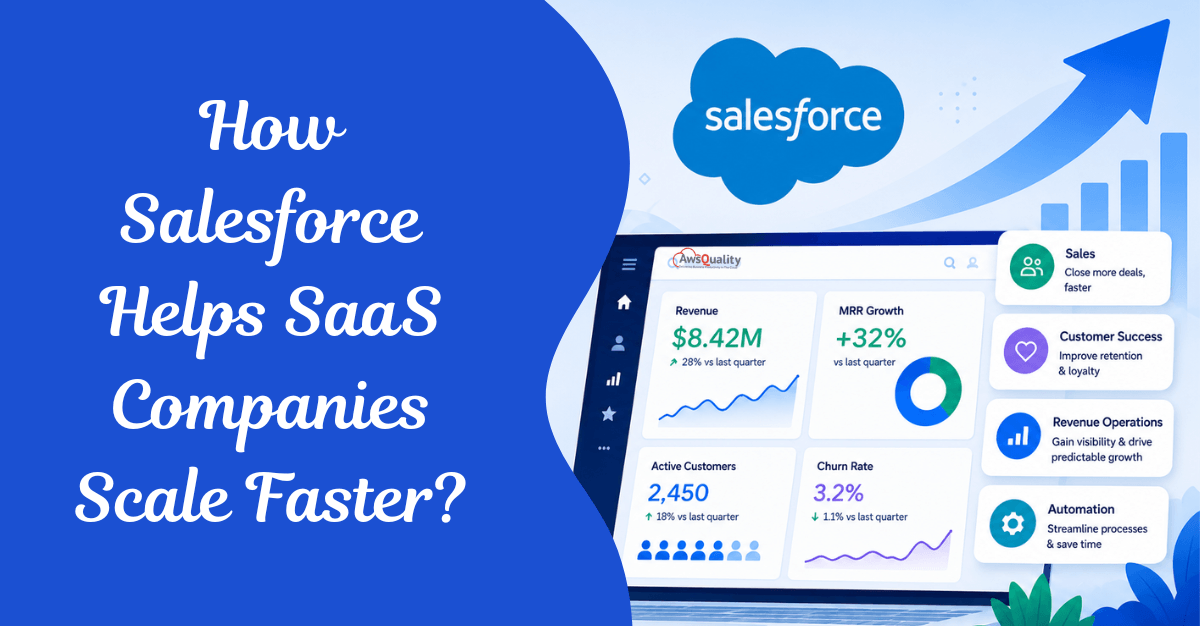
Scaling a SaaS company is not just about acquiring more customers — it’s about managing growth efficiently without breaking operations, customer experience, or revenue workflows.
As SaaS businesses grow, they often face challenges like:
- Disconnected customer data
- Inefficient sales processes
- Poor visibility into revenue metrics
- Manual onboarding and support workflows
- Scaling customer success operations
This is where Salesforce becomes a strategic growth platform.
More than just a CRM, Salesforce enables SaaS companies to build scalable revenue operations, automate workflows, improve customer retention, and gain real-time visibility across the business.
In this guide, we explore how Salesforce helps SaaS companies scale faster in 2026 and beyond.
Why SaaS Companies Need a Scalable CRM
Scaling a SaaS company is fundamentally different from scaling a traditional business. SaaS growth is driven by recurring revenue, low churn, fast sales cycles, product-led expansion, and the ability to serve hundreds or thousands of customers simultaneously — without proportional increases in headcount.
Salesforce is the world’s leading CRM platform, and it has become the operational backbone for thousands of SaaS companies — from Series A startups finding product-market fit to publicly traded enterprises managing hundreds of millions in ARR. The reason is straightforward: Salesforce is purpose-built for the kind of relationship-driven, data-intensive, subscription-based growth that SaaS companies depend on.
This guide breaks down exactly how Salesforce helps SaaS companies scale faster — across sales, marketing, customer success, product analytics, and operational efficiency.
The SaaS Scaling Challenge
Before exploring how Salesforce solves it, it helps to understand what makes SaaS scaling uniquely complex.
Revenue complexity. SaaS revenue is not transactional — it is recurring, often tiered, and subject to expansion, contraction, and churn. Tracking MRR, ARR, NRR, churn rate, and expansion revenue across hundreds of accounts requires a system designed for subscription economics, not one-time sales.
Customer lifecycle complexity. A SaaS customer goes through a long lifecycle: awareness, trial, onboarding, adoption, renewal, expansion, and advocacy. Each stage requires different touchpoints, different teams, and different data — all of which need to be connected for a coherent customer experience.
Sales motion complexity. SaaS companies often run multiple sales motions simultaneously — product-led growth (PLG), inside sales, field sales, and channel partnerships. Managing all of these with disconnected tools creates data silos, reporting gaps, and lost revenue opportunities.
Scale without proportional cost. The defining characteristic of SaaS economics is that revenue should scale faster than costs. That requires automation, process standardization, and intelligent tooling — not more headcount doing manual work.
Salesforce addresses every one of these challenges with a platform that grows with the business.
How Salesforce Helps SaaS Companies Scale
1. Centralizing the Customer Data Foundation
The most fundamental thing Salesforce does for a SaaS company is create a single source of truth for every customer relationship. In the early stages of a SaaS company, customer data is scattered — some in spreadsheets, some in email threads, some in the product database, some in billing systems. This fragmentation creates blind spots that slow growth.
- Unified account and contact management
- 360-degree customer view
- Custom objects for SaaS-specific data
- Why it accelerates scale
2. Accelerating the SaaS Sales Cycle
Salesforce’s Sales Cloud is the engine that helps SaaS sales teams move faster, qualify better, and close more deals — without adding proportionally more reps.
- Pipeline management and forecasting
- Lead routing and assignment
- Sales cadences and engagement
- CPQ for SaaS pricing complexity
- Opportunity splitting and partner deals
- Impact on scale
3. Driving SaaS Marketing and Pipeline Generation
Salesforce’s Marketing Cloud and the Salesforce-native Pardot (now Marketing Cloud Account Engagement) help SaaS marketing teams generate more pipeline, nurture leads more effectively, and attribute revenue to marketing investments.
- Lead capture and scoring
- Automated nurture journeys
- Account-based marketing (ABM)
- Campaign attribution and ROI
- Product-led growth (PLG) integration
4. Scaling Customer Success and Reducing Churn
For SaaS companies, retaining existing customers is as important as acquiring new ones. A 5% improvement in retention can increase profitability by 25–95% over time. Salesforce’s Service Cloud and Customer Success tooling give CS teams the data and workflow automation they need to protect and grow existing revenue.
- Health scoring and early warning systems
- Renewal management
- Expansion revenue identification
- Escalation management
- Customer Success Plans
- QBR and engagement tracking
5. Automating Operations with Salesforce Flow
Manual processes are the enemy of SaaS scale. Every manual handoff, every spreadsheet updated by hand, every Slack message asking “can you update the CRM?” is an opportunity for error and a drag on growth. Salesforce Flow — the platform’s built-in automation engine — eliminates manual work across the business.
- Lead-to-opportunity automation
- Contract and billing automation
- Renewal and expansion workflows
- Approval processes
- Reporting and alerting
6. SaaS Metrics, Reporting, and Revenue Intelligence
You cannot scale what you cannot measure. Salesforce provides SaaS companies with the reporting and analytics infrastructure to track the metrics that drive SaaS growth decisions.
- Native SaaS dashboards
- Salesforce Revenue Cloud
- Einstein Analytics (Tableau CRM)
- Revenue forecasting
- Cohort analysis and retention metrics
7. Scaling Through the Salesforce AppExchange Ecosystem
One of Salesforce’s most powerful advantages for SaaS scaling is its ecosystem. The AppExchange contains over 7,000 applications built specifically to extend Salesforce — and many of the most valuable ones are purpose-built for SaaS companies.
- Subscription and billing management
- Customer success platforms
- Revenue intelligence
- E-signature and contract management
- Data enrichment
8. Supporting International and Enterprise Scale
As SaaS companies grow from SMB to mid-market to enterprise and from one country to many, Salesforce scales with them without requiring a platform change.
- Multi-currency and multi-language support
- Territory management
- Role hierarchy and data security
- Compliance and data residency
- Sandbox environments
Salesforce ROI for SaaS Companies: What the Data Shows
Organizations that implement Salesforce effectively report measurable business outcomes:
- 25% increase in sales revenue on average, according to Salesforce’s own customer data.
- 30% improvement in sales rep productivity from automation of administrative tasks and better lead prioritization.
- 26% increase in win rate from better pipeline visibility and sales process standardization.
- 32% faster deployment of new features when Salesforce is used to coordinate cross-functional go-to-market motions.
- Reduction in customer churn from CS teams using health scoring and renewal automation — typically 10–25% churn rate improvement in the first year.
For a SaaS company with $5M ARR and a 15% annual churn rate, a 20% improvement in churn rate (to 12%) represents $150,000 in saved annual recurring revenue — often exceeding the annual Salesforce investment at that scale.
How Salesforce Reduces Operational Costs
Although Salesforce requires investment, it often reduces operational costs by:
- Automating repetitive work
- Reducing manual errors
- Improving team productivity
- Lowering customer churn
- Accelerating revenue growth
Many SaaS companies recover implementation costs through:
- Higher retention
- Faster sales cycles
- Improved operational efficiency
Common Salesforce Use Cases for SaaS Companies
Sales Automation
Automate lead management, opportunity tracking, and renewals.
Customer Success Management
Track customer health, onboarding, and retention workflows.
SaaS Revenue Operations
Manage subscriptions, forecasting, and expansion revenue.
Support & Ticketing
Integrate customer support into a centralized customer view.
Product-Led Growth (PLG)
Connect product usage data with CRM workflows.
Common Mistakes SaaS Companies Make
Over-Customizing Too Early
Excessive customization creates long-term complexity.
Ignoring Integration Strategy
Disconnected tools reduce CRM effectiveness.
Poor Data Governance
Inaccurate data leads to unreliable reporting.
Underinvesting in User Adoption
Even the best CRM fails if teams do not use it properly.
Best Practices for Scaling with Salesforce
Start with Core Workflows
Implement high-impact processes first.
Automate Gradually
Avoid over-automation in early stages.
Focus on Clean Data
Strong reporting depends on data quality.
Align Sales, Marketing & Success Teams
Salesforce works best when all customer-facing teams are connected.
Measure KPIs Continuously
Track:
- Churn
- MRR growth
- Pipeline velocity
- Customer health
Salesforce ROI for SaaS Companies
SaaS businesses using Salesforce effectively often see:
- Faster sales cycles
- Higher customer retention
- Improved forecast accuracy
- Better cross-team collaboration
- Increased operational efficiency
For high-growth SaaS companies, Salesforce becomes more than a CRM — it becomes the operational backbone of scalable growth.
Frequently Asked Questions
1. Is Salesforce good for SaaS startups?
Yes. Startups can begin with lightweight Salesforce setups and scale over time.
2. Can Salesforce manage subscriptions?
Yes. Salesforce integrates with subscription billing and revenue management platforms.
3. Does Salesforce support product-led growth (PLG)?
Yes. Product usage data can be integrated into Salesforce workflows and customer success operations.
4. How long does Salesforce implementation take?
- Small SaaS companies: 4–8 weeks
- Mid-sized SaaS businesses: 2–4 months
- Enterprise SaaS organizations: 4–9 months
5. What is the difference between Salesforce Sales Cloud and Revenue Cloud for SaaS?
Sales Cloud focuses on pipeline management, lead qualification, opportunity tracking, and sales productivity — it is the foundation of SaaS sales operations. Revenue Cloud extends this with CPQ (quoting and pricing), billing, contract management, and ASC 606-compliant revenue recognition — the additional layer needed once SaaS revenue complexity (tiers, usage billing, annual contracts) outgrows what Sales Cloud alone can manage.
6. How long does it take for a SaaS company to see results from Salesforce?
Most SaaS companies see initial productivity improvements within 60–90 days of a well-implemented Salesforce go-live — driven by better pipeline visibility, automated lead routing, and elimination of manual tasks. Deeper outcomes (improved win rate, measurable churn reduction, accurate revenue forecasting) typically materialize over 6–12 months as the team adopts new processes and data accumulates.
Final Thoughts
Salesforce helps SaaS companies scale faster by solving the core operational challenges of subscription-based growth: fragmented customer data, inconsistent sales processes, manual operational overhead, reactive customer success, and limited revenue visibility.
The companies that scale fastest on Salesforce share a common approach: they invest in a clean data model early, integrate their product data to power CS and expansion motions, automate the manual work that consumes their teams, and measure the business outcomes that matter — not just the CRM adoption metrics.
At every stage of the SaaS journey — from the first 100 customers to the first $100M in ARR — Salesforce provides the infrastructure, flexibility, and ecosystem to grow without being constrained by the operational tools underneath.
Ready to Scale Your SaaS Business with Salesforce?
Whether you’re implementing Salesforce for the first time or optimizing an existing setup, the right strategy can dramatically improve growth efficiency and operational scalability.
 Bio
Bio