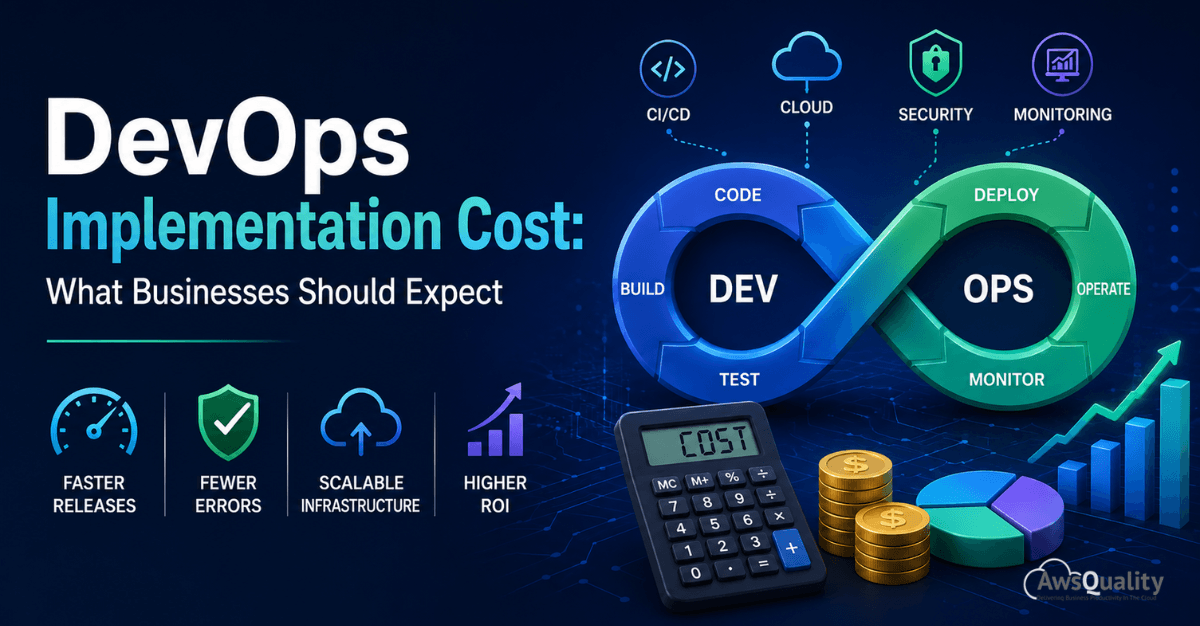
DevOps has become a critical driver of modern software delivery—helping businesses release faster, reduce errors, and scale efficiently. But one of the most common questions organizations ask is:
👉 “How much does DevOps implementation actually cost?”
The answer depends on multiple factors including team size, infrastructure, tools, and project complexity. In this guide, we break down realistic DevOps costs, what drives them, and how to optimize your investment.
What is DevOps Implementation?
DevOps implementation is the process of integrating development and operations practices to enable:
- Continuous Integration & Continuous Deployment (CI/CD)
- Infrastructure automation
- Faster release cycles
- Improved system reliability
It typically involves tools, processes, and cultural transformation—not just technology.
What is DevOps Implementation Cost?
DevOps implementation cost refers to the total investment a business makes to adopt, build, and sustain a DevOps culture, toolchain, and operational model. It encompasses far more than software licenses — it includes people, processes, infrastructure, training, and the ongoing operational overhead of running a modern software delivery pipeline.
Understanding what DevOps implementation costs is critical because organizations consistently underestimate it. Teams budget for tools but overlook training. They account for cloud infrastructure but not for the engineering hours spent configuring and maintaining CI/CD pipelines. They hire DevOps engineers but don’t plan for the cultural transformation that makes those engineers effective.
This guide breaks down every cost category you should expect, provides realistic budget ranges by business size, and outlines what drives costs up — and how to control them.
Read: How to Build a CI/CD Pipeline – Step-by-Step Guide
Why DevOps Implementation Costs Vary So Widely
DevOps implementation costs range from as little as $10,000 for a small startup adopting open-source tooling to several million dollars for a large enterprise undergoing a full-scale digital transformation. The variance comes from five key factors:
- Organization size. More teams, more codebases, more legacy systems, and more compliance requirements all increase implementation scope and cost.
- Current maturity level. A team already practicing agile with some automation in place needs far less investment than one running waterfall processes on monolithic on-premises infrastructure.
- Build vs. buy decisions. Organizations that build custom tooling internally pay in engineering hours. Those that adopt managed SaaS platforms pay in subscription fees. Neither is always cheaper.
- Cloud vs. on-premises infrastructure. Cloud-native DevOps implementations trade capital expenditure for operational expenditure. On-premises implementations require hardware investment upfront but may cost less at scale.
- Scope of transformation. Some organizations implement DevOps for a single team or product line. Others roll it out across the entire engineering organization simultaneously. Scope is the single biggest cost multiplier.
Also read: Why Most DevOps Transformations Fail (And How to Fix Them)
Total DevOps Implementation Cost by Business Size
Here are realistic total first-year implementation cost ranges:
| Business Size | Year 1 Implementation Cost | Ongoing Annual Cost (Year 2+) |
|---|---|---|
| Startup (1–50) | $50,000 – $200,000 | $30,000 – $120,000 |
| SMB (50–250) | $200,000 – $700,000 | $150,000 – $500,000 |
| Mid-market (250–1,000) | $700,000 – $2,500,000 | $500,000 – $1,500,000 |
| Enterprise (1,000+) | $2,500,000 – $10,000,000+ | $1,500,000 – $5,000,000+ |
Year 1 costs are higher due to initial setup, consulting, toolchain procurement, and the productivity dip during transition. From year 2 onwards, costs stabilize into a more predictable operational expenditure model — provided toolchain sprawl and scope creep are managed.
👉 Costs vary based on:
- Automation level
- AI integration
- Infrastructure scale
- Compliance requirements
Key Cost Drivers in Modern DevOps
1. Talent and Staffing Costs
- DevOps Engineer. Salaries range from $110,000 to $165,000 annually.
- Site Reliability Engineer (SRE). Salaries 10–20% above DevOps engineers
- Cloud Architect. Salaries range from $140,000–$200,000 annually.
- Security Engineer (DevSecOps). This role adds $120,000–$175,000 to annual staffing costs.
- Platform Engineer. Salaries align closely with senior DevOps engineers.
2. Toolchain and Software Costs
| Organization Size | Open Source Heavy | Mixed | SaaS Heavy |
|---|---|---|---|
| Startup | $2,000 – $8,000 | $8,000 – $25,000 | $25,000 – $60,000 |
| SMB | $5,000 – $20,000 | $20,000 – $80,000 | $60,000 – $150,000 |
| Mid-market | $15,000 – $50,000 | $60,000 – $200,000 | $150,000 – $400,000 |
| Enterprise | $30,000 – $100,000 | $150,000 – $500,000 | $400,000 – $1,000,000+ |
3. Cloud Infrastructure Costs
| Organization Size | Annual Cloud Infrastructure |
|---|---|
| Startup | $6,000 – $30,000 |
| SMB | $30,000 – $120,000 |
| Mid-market | $100,000 – $500,000 |
| Enterprise | $500,000 – $5,000,000+ |
4. Training and Upskilling Costs
| Organization Size | Annual Training Cost |
|---|---|
| Startup | $3,000 – $10,000 |
| SMB | $10,000 – $40,000 |
| Mid-market | $35,000 – $120,000 |
| Enterprise | $100,000 – $500,000+ |
5. Consulting and Implementation Partner Costs
- DevOps consulting firms. Specialized boutique firms charge $150–$350/hour for experienced DevOps architects and consultants. A typical initial engagement — assessing current state, designing the target architecture, setting up the core pipeline, and mentoring the internal team — runs 200–500 hours, representing a $30,000–$175,000 investment.
- Systems integrators (SIs). Large SIs (Accenture, Capgemini, Deloitte, Infosys) offer end-to-end DevOps transformation programs. Enterprise engagements typically range from $500,000 to several million dollars depending on scope and duration.
- Cloud provider professional services. AWS Professional Services, Google Cloud Professional Services, and Microsoft Azure Consulting charge $200–$350/hour. A structured engagement typically costs $50,000–$250,000.
- Freelance DevOps engineers. For specific implementation tasks (pipeline setup, IaC templates, monitoring configuration), freelance engineers on platforms like Toptal or Upwork charge $75–$200/hour. A scoped project might run $15,000–$60,000.
6. Security and Compliance (DevSecOps) Costs
7. Hidden and Ongoing Costs
- Productivity loss during transition. During the DevOps adoption period, teams are learning new tools and processes while simultaneously delivering product. Research suggests a 15–30% productivity dip during the transition period of 3–6 months. For a team of 20 engineers at an average fully loaded cost of $150,000/year, a 20% productivity dip for 4 months represents approximately $200,000 in opportunity cost.
- Pipeline maintenance. CI/CD pipelines, IaC templates, and monitoring configurations require continuous maintenance. Industry estimates suggest 15–25% of DevOps engineering capacity is consumed by maintaining the pipeline rather than improving it. This is a permanent ongoing cost.
- License true-ups. SaaS tools priced per user or per host grow in cost as the organization grows. A tool that costs $50,000/year at 200 employees may cost $200,000/year at 800 employees — with no negotiation leverage if the pricing wasn’t locked in contractually.
- Toolchain sprawl. Organizations frequently adopt tools opportunistically — one team uses CircleCI, another GitHub Actions, a third Jenkins. Fragmented toolchains multiply licensing costs, training costs, and maintenance overhead. Consolidation projects to rationalize toolchains often cost $50,000–$200,000 in engineering time.
- Incident response and on-call costs. DevOps teams take operational responsibility for production systems. On-call rotation, incident response processes, and postmortem practices require engineering time and tooling (PagerDuty, OpsGenie: $20–$60/user/month) that must be accounted for.
How to Reduce DevOps Implementation Costs Without Cutting Corners
Start with open-source tooling
Jenkins, Kubernetes, Terraform, Prometheus, Grafana, and Ansible are all open source and enterprise-grade. Starting with the open-source tier of these tools can reduce toolchain costs by 60–80% compared to fully commercial alternatives. As you scale, you can selectively introduce commercial tools where the value justifies the cost.
Adopt a phased implementation approach
Attempting to implement everything simultaneously maximizes disruption, risk, and cost. A phased approach — starting with source control and CI, then adding CD, then adding monitoring, then adding IaC — spreads investment over 12–18 months, allows learning before scaling, and limits the productivity dip to a smaller surface area at any given time.
Invest in training before tooling
Organizations that train their existing engineers before deploying new tools get significantly more value from those tools faster. A trained team configures a tool correctly the first time, requires less rework, and maintains it more efficiently. Training costs are almost always recouped in reduced consulting and rework costs.
Consolidate your toolchain intentionally
Choose tools strategically, not opportunistically. Standardize on one CI/CD platform, one IaC tool, one monitoring stack. Fewer tools mean lower licensing costs, lower training overhead, and less maintenance complexity. GitHub or GitLab can replace several separate tools (source control, CI/CD, artifact management, security scanning) in a single subscription.
Use cloud cost optimization practices from day one
Cloud costs are the most elastic and hardest-to-predict component of DevOps spending. Implement cloud cost management from the start: right-size instances, use spot/preemptible instances for CI/CD workloads, implement auto-scaling, set up budget alerts, and review cost reports weekly. Organizations that implement FinOps practices early typically reduce cloud spend by 20–35%.
Consider managed DevOps services for early-stage organizations
For startups and SMBs, engaging a managed DevOps service provider for the first 12–24 months is often more cost-effective than hiring and onboarding in-house talent. Once the organization has enough engineering scale and DevOps maturity to justify a dedicated internal team, transitioning at that point is lower-risk and better-informed.
DevOps ROI: What You Get Back on the Investment
DevOps implementation costs are significant — but so is the return when implementation is done well. Organizations that successfully implement DevOps report:
- Deployment frequency. High-performing DevOps teams deploy to production multiple times per day versus monthly or quarterly for low-performing teams. Faster deployment means faster time to market and faster response to customer feedback.
- Lead time for changes. The time from code commit to production deployment drops from weeks or months to hours or days. This reduces the cost of delivering features and fixes significantly.
- Change failure rate. DevOps practices (automated testing, canary deployments, feature flags) reduce the percentage of deployments that cause production incidents from 15–60% in low-performing teams to 0–15% in high-performing teams.
- Mean time to recovery (MTTR). When incidents do occur, DevOps teams recover faster — mean time to recovery drops from days to hours or minutes, reducing the revenue impact of downtime.
- Engineering productivity. Eliminating manual processes, reducing context switching, and providing self-service infrastructure frees engineers to spend more time on product development and less on operational tasks.
According to the annual DORA (DevOps Research and Assessment) State of DevOps report, elite DevOps performers are 2× more likely to meet or exceed their organizational performance goals, and software delivery performance correlates directly with organizational profitability and market share.
Frequently Asked Questions
1. How long does DevOps implementation take?
- Small setups: 4–8 weeks
- Mid-sized: 2–4 months
- Enterprise: 4–9 months
2. Is DevOps expensive for startups?
No. Startups can begin with lean setups using open-source tools and scale over time.
3. Does AI increase DevOps costs?
Initially yes, but it reduces long-term operational costs through automation and efficiency.
4. What is the biggest cost driver in DevOps?
Talent and expertise remain the largest cost factor.
Summary
DevOps implementation is a multi-year investment that spans people, tooling, infrastructure, training, and cultural change. There is no single right number — costs scale with organization size, current maturity, scope of transformation, and build-vs-buy decisions across every layer of the stack.
What is consistent across successful implementations is this: organizations that budget realistically — accounting for talent, toolchain, infrastructure, training, consulting, and the hidden costs of transition — achieve transformations that deliver lasting competitive advantage. Organizations that underbudget typically stall mid-transformation, accumulate technical debt in their DevOps infrastructure, and fail to realize the productivity and reliability gains that make the investment worthwhile.
Plan thoroughly, phase the implementation intelligently, invest in your people before your tools, and measure outcomes against the DORA metrics from the start. DevOps done right is not a cost center — it is one of the highest-return investments an engineering organization can make.
Ready to Implement DevOps?
If you’re planning a modern DevOps transformation with AI, automation, and scalability, working with experienced consultants can significantly reduce cost and risk.
 Bio
Bio