
Build Reliable, Scalable Data Infrastructure for Analytics, AI, and Business Growth
Turn fragmented, complex, and underutilized data into a trusted foundation for analytics, automation, and AI with our data engineering services.
AwsQuality helps businesses design, build, modernize, and manage scalable data ecosystems. As a data engineering company, we deliver end-to-end data engineering solutions spanning data pipelines, ETL and ELT, cloud data platforms, data warehouses, data lakes, integration, migration, modernization, and real-time data processing.
Whether you are starting from scratch, modernizing a legacy data stack, or scaling existing infrastructure to handle growing data volumes, our certified data engineers deliver production-grade solutions on time and on budget.
Build a Data Foundation That Moves Your Business Forward
Connect with Data Engineering Expert
What is Data Engineering?
Data engineering is the discipline of designing, building, and maintaining the systems and infrastructure that collect, store, transform, and deliver data at scale. It is the foundational layer that makes business intelligence, data analytics, machine learning, and AI possible.
Without data engineering, organizations are left with fragmented data stored across disconnected systems — CRMs, ERPs, cloud applications, databases, and third-party APIs — that cannot be combined, trusted, or analyzed effectively. Data engineering solves this by creating reliable, automated pipelines that move data from where it lives to where it is needed, in a format that is clean, consistent, and current.
A data engineering function typically encompasses:
- Data ingestion — collecting data from APIs, databases, SaaS platforms, event streams, and files
- Data transformation — cleaning, standardizing, enriching, and reshaping raw data into usable formats
- Data storage — designing and managing data warehouses, data lakes, and lakehouses for structured and unstructured data
- Data pipelines — automating the movement and transformation of data from source to destination at scale
- Data integration — connecting disparate systems so data flows automatically across the organization
- Data governance — ensuring data quality, security, lineage, and compliance throughout the data lifecycle
AwsQuality provides all of these capabilities as a managed data engineering service — giving businesses the infrastructure they need to become data-driven, without the time, cost, and complexity of building an in-house team.
Our Data Engineering Services
AwsQuality provides end-to-end data engineering services for businesses at different stages of their data journey—from organizations building their first centralized data platform to enterprises modernizing complex data ecosystems.
Data Engineering Consulting
A successful data platform starts with the right architecture and strategy.
Our data engineering consulting services help businesses assess their existing data environment, identify technical and operational gaps, and create a practical roadmap for building or modernizing their data infrastructure.
Our consultants can help with:
- Current-state data architecture assessment
- Data platform strategy and roadmap development
- Cloud and technology selection
- Data architecture design
- Data integration planning
- Data pipeline architecture
- Data warehouse and data lake strategy
- Data modernization planning
- Scalability and performance assessment
- Data quality and governance considerations
- Analytics and AI readiness
As a data engineering consultancy, we focus on aligning technical decisions with business priorities. The goal is not to introduce more technology than you need, but to create an architecture that supports your current requirements and future growth.
Book Data Engineering Consultation
Data Pipeline Development
Reliable data pipelines are the backbone of a modern data ecosystem.
Our data pipeline development services help businesses move data efficiently between applications, databases, cloud platforms, data warehouses, data lakes, and analytics environments.
We design batch, streaming, and event-driven pipelines based on your business and technical requirements.
Our data pipeline services include:
- Batch data pipeline development
- Real-time and streaming pipelines
- API-based data ingestion
- Database-to-database pipelines
- Cloud data pipelines
- Automated data transformation
- Pipeline orchestration
- Error handling and recovery
- Pipeline monitoring and observability
- Performance optimization
- Pipeline modernization
We build pipelines with reliability, scalability, maintainability, and data quality in mind—helping reduce the risk of broken reports, delayed insights, and inconsistent downstream data.
ETL and ELT Development Services
Data often needs to be extracted, cleaned, standardized, transformed, and validated before it can support reporting or analytics.
Our ETL development services help businesses create automated data workflows that transform information from multiple sources into structured, usable datasets.
We support:
- ETL pipeline design and development
- ELT architecture and implementation
- Data extraction from multiple sources
- Data cleansing and standardization
- Business-rule implementation
- Data transformation
- Workflow orchestration
- Incremental and change data capture processes
- ETL testing and validation
- Legacy ETL modernization
- Performance tuning
We help organizations choose between ETL and ELT approaches based on data volume, architecture, cloud environment, latency requirements, and analytics use cases.
Data Integration Services
Disconnected systems create disconnected decisions.
Our data integration services help organizations connect applications, databases, APIs, SaaS platforms, cloud environments, and enterprise systems to create more consistent and accessible data flows.
We support integration across:
- CRM systems
- ERP platforms
- Business applications
- Cloud services
- APIs
- Relational and NoSQL databases
- Data warehouses
- Data lakes
- Analytics platforms
- Legacy systems
- Third-party data sources
Our approach focuses on creating reliable data movement while maintaining consistency across systems.
Whether you need point-to-point integration, API-driven connectivity, event-based data exchange, or a broader enterprise integration architecture, we help create a connected data ecosystem.
Cloud Data Engineering Services
Cloud platforms give businesses the flexibility to process and analyze data at scale—but successful cloud adoption requires more than simply moving existing workloads.
Our cloud data engineering services help businesses design and build cloud-native data platforms optimized for scalability, performance, availability, and operational efficiency.
Our capabilities include:
- Cloud data architecture
- Cloud data platform implementation
- Data pipeline development
- Cloud data migration
- Data warehouse modernization
- Data lake implementation
- ETL and ELT workflows
- Real-time data processing
- Data platform optimization
- Hybrid and multi-cloud data integration
We work with modern cloud ecosystems to help organizations build flexible data foundations for analytics, business intelligence, machine learning, and AI.
AWS Data Engineering
Our AWS data engineering services help organizations build scalable data environments using services and technologies across the AWS ecosystem.
We can help with:
- AWS data architecture
- Cloud data pipelines
- Data ingestion and transformation
- Data lake architecture
- Data warehousing
- Data processing workflows
- Streaming data architectures
- Data migration to AWS
- Analytics-ready data platforms
- Existing AWS data platform modernization
We design AWS-based data solutions around your workload, integration, analytics, scalability, and operational requirements.
Azure Data Engineering
Our Azure data engineering services help businesses create connected, cloud-based data platforms within the Microsoft ecosystem.
Our capabilities include:
- Azure data architecture
- Data ingestion pipelines
- ETL and ELT development
- Cloud data integration
- Data warehouse implementation
- Data lake architecture
- Data migration
- Data processing and transformation
- Analytics platform enablement
- Data platform modernization
For businesses already using Microsoft technologies, we help create an integrated data environment that supports analytics and broader digital transformation initiatives.
Data Warehouse Services
A well-designed data warehouse gives business teams a consistent source of structured information for reporting, analysis, and decision-making.
Our data warehouse services help businesses design, develop, migrate, and modernize analytical data environments.
We support:
- Data warehouse architecture
- Data modeling
- Data ingestion
- ETL and ELT development
- Cloud data warehouse implementation
- Data mart development
- Legacy warehouse modernization
- Data warehouse migration
- Performance optimization
- Analytics and BI integration
We focus on creating data warehouses that make trusted information easier to access and analyze across business functions.
Data Lake Services
Organizations increasingly need to manage structured, semi-structured, and unstructured data at scale.
Our data lake services help businesses create centralized data environments capable of supporting diverse data types and use cases.
Our capabilities include:
- Data lake strategy
- Architecture and implementation
- Data ingestion
- Data organization and storage
- Data processing
- Metadata considerations
- Data quality workflows
- Data lake integration
- Analytics enablement
- Data lake modernization
We help organizations avoid the common problem of creating a data repository without sufficient structure, usability, or governance.
The objective is to build a data lake that supports real business use cases—not simply a place to store more data.
Modern Data Stack Implementation
Legacy data environments can become difficult to scale, expensive to maintain, and too slow for modern analytics requirements.
We help businesses design and implement a modern data stack that connects data ingestion, storage, transformation, orchestration, quality, and analytics technologies into a cohesive ecosystem.
A modern data stack may include:
- Cloud-native data platforms
- Automated data ingestion
- ELT workflows
- Cloud data warehouses
- Data lakes and lakehouse architectures
- Data transformation layers
- Workflow orchestration
- Data quality and observability
- Business intelligence platforms
- Machine learning and AI environments
Our technology recommendations are based on business needs and architectural fit rather than unnecessary platform complexity.
Enterprise Data Engineering
Enterprise data environments are rarely simple.
Large organizations often manage data across business units, geographic locations, cloud platforms, legacy applications, acquired systems, and specialized business applications.
Our enterprise data engineering services help organizations build scalable architectures capable of supporting complex data ecosystems.
We help address:
- Data silos across departments
- Large-scale data integration
- Complex data dependencies
- High-volume data processing
- Legacy infrastructure
- Multi-cloud and hybrid environments
- Enterprise analytics requirements
- Data quality challenges
- Platform scalability
- AI and machine learning readiness
Our goal is to create a data foundation that can evolve as your organization, technology landscape, and data requirements change.
Data Modernization Services
Legacy data systems can limit analytics, increase maintenance costs, and make it difficult to adopt cloud, AI, and modern business intelligence capabilities.
Our data modernization services help organizations move from fragmented and outdated infrastructure toward scalable, cloud-ready data platforms.
We support:
- Legacy data platform assessment
- Modernization strategy
- Legacy ETL modernization
- Cloud migration
- Data warehouse modernization
- Data lake and lakehouse implementation
- Pipeline redesign
- Architecture modernization
- Performance optimization
- Modern analytics enablement
We take a phased approach to modernization, helping businesses reduce unnecessary disruption while progressively improving their data capabilities.
Data Migration Services
Data migration is not simply about moving information from one location to another. The data must remain accurate, complete, consistent, and usable throughout the transition.
Our data migration services support migrations between:
- Legacy and modern systems
- On-premises and cloud environments
- Databases
- Data warehouses
- Data lakes
- Business applications
- Cloud platforms
Our migration approach can include:
Assess → Map → Clean → Transform → Migrate → Validate → Optimize
We focus on data integrity, validation, reconciliation, and business continuity throughout the migration lifecycle.
Snowflake Consulting
Our Snowflake consulting capabilities help organizations design, implement, optimize, and modernize cloud data environments using Snowflake.
We can support:
- Snowflake architecture
- Data migration
- Data ingestion
- ETL and ELT pipelines
- Data modeling
- Data warehouse modernization
- Performance optimization
- Analytics enablement
- Existing environment assessment
Whether you are considering Snowflake or optimizing an existing implementation, we help align the platform with your data and analytics requirements.
Databricks Consulting
Our Databricks consulting capabilities help businesses build scalable data processing and analytics environments for complex data workloads.
We can help with:
- Databricks architecture
- Data engineering workflows
- Data pipeline development
- Data processing
- Lakehouse architecture
- Data transformation
- Platform migration
- Performance optimization
- Analytics and AI data preparation
We help organizations use Databricks as part of a broader data ecosystem rather than as an isolated technology implementation.
Request a Data Engineering Assessment
Data Engineering Challenges We Help Businesses Solve
Businesses often struggle to turn growing volumes of data into reliable, actionable information. Data may be scattered across business applications, cloud platforms, databases, and third-party systems. Without a well-designed data engineering foundation, teams can face inconsistent reports, delayed analytics, unreliable pipelines, and increasing infrastructure costs.
AwsQuality helps businesses address these challenges through data engineering services tailored to their data environments, business requirements, and technology stack.
Data Silos and Disconnected Systems
When business data is distributed across CRM platforms, ERP systems, databases, APIs, and cloud applications, obtaining a consistent view of operations becomes difficult. Data engineering helps connect these sources through reliable ingestion and transformation pipelines, making relevant data available for reporting, analytics, and downstream applications.
Unreliable Data Pipelines
Failed jobs, delayed updates, inconsistent transformations, and missing records can undermine business reporting. Well-designed data pipelines incorporate validation, error handling, monitoring, and recovery mechanisms to improve data reliability and reduce manual intervention.
Slow Reporting and Analytics
When data preparation depends on manual processes or inefficient queries, business teams may wait hours or days for usable information. Optimized ingestion, transformation, storage, and processing workflows help make trusted data available more efficiently for business intelligence and analytical workloads.
Legacy Data Infrastructure
Older data platforms may struggle with growing workloads, changing business requirements, and integration with modern cloud services. Data platform modernization can help organizations improve scalability, simplify data management, and prepare their infrastructure for evolving analytical requirements.
Data Quality and Governance Challenges
Inconsistent definitions, duplicate records, incomplete fields, and limited data lineage can affect the accuracy of business decisions. Data quality checks, metadata management, access controls, and governance practices help organizations maintain more consistent and trustworthy data.
Preparing Data for AI and Machine Learning
AI applications depend on accessible, well-structured, relevant, and appropriately governed data. Data engineering helps prepare the underlying foundation through data integration, transformation, validation, historical data management, and retrieval-ready data pipelines that support analytics, machine learning, and AI applications.
Our Data Engineering Implementation Approach
Effective data engineering requires more than connecting data sources. It involves designing, building, testing, and maintaining data workflows that meet business requirements and remain reliable as data volumes and use cases evolve.
AwsQuality approaches data engineering projects through the following stages, adapted to the scope and complexity of each engagement.
1. Data Assessment and Requirements Analysis
We begin by understanding business objectives, existing data sources, reporting requirements, data volumes, security considerations, and current infrastructure. This assessment helps identify integration challenges, data quality issues, bottlenecks, and opportunities for improvement.
2. Data Architecture and Solution Design
Based on the assessment, the data engineering solution is designed around the organization’s workload, scalability requirements, cloud environment, and analytical needs. This may involve selecting appropriate ingestion methods, storage layers, transformation patterns, orchestration tools, and data access controls.
3. Data Pipeline Development and Integration
Data pipelines are developed to extract, ingest, transform, validate, and deliver data from relevant sources. Depending on the use case, the architecture may support batch processing, incremental ingestion, streaming data, API integrations, or a combination of approaches.
4. Data Validation and Testing
Testing helps verify that data is complete, consistent, accurate, and processed as expected. Relevant checks may include schema validation, record counts, duplicate detection, transformation testing, reconciliation, and failure handling.
5. Deployment, Monitoring and Optimization
After testing, pipelines are deployed into the target environment with appropriate monitoring and operational controls. Performance, processing latency, failures, resource consumption, and data freshness can be monitored to identify opportunities for ongoing optimization.
6. Continuous Improvement
As business requirements and data volumes change, data engineering workflows may need additional sources, revised transformations, improved data models, or infrastructure changes. Continuous improvement helps maintain alignment between the data platform and evolving business needs.
Data Quality, Governance and Pipeline Reliability
A data platform is valuable only when the information it delivers can be trusted and used appropriately. Data quality, governance, and operational reliability should therefore be considered throughout the data engineering lifecycle, rather than added only after pipelines are built.
Data Quality Validation
Data quality checks help identify missing values, duplicates, invalid formats, unexpected schema changes, and inconsistencies between source systems. Validation rules can be incorporated into data pipelines so that issues are detected before unreliable data reaches downstream dashboards, analytics models, or AI applications.
Data Lineage and Traceability
Data lineage helps teams understand where information originates, how it is transformed, and which downstream reports or systems depend on it. Better traceability supports troubleshooting, impact analysis, and more transparent data management.
Pipeline Monitoring and Error Handling
Monitoring helps identify failed jobs, processing delays, unexpected data volumes, and freshness issues. Depending on the architecture, pipelines can incorporate logging, alerting, retry mechanisms, recovery procedures, and failure notifications to support more reliable operations.
Security and Access Management
Data engineering architectures should account for data sensitivity, access permissions, encryption requirements, retention policies, and applicable compliance obligations. Appropriate controls help protect data throughout ingestion, storage, transformation, and delivery.
Performance and Cost Optimization
Data platforms can become expensive when processing is inefficient, resources are oversized, or workloads run unnecessarily. Query optimization, incremental processing, appropriate storage formats, workload scheduling, and resource monitoring can help improve performance and control operating costs.
The specific controls and technologies used depend on the organization’s existing infrastructure, data sensitivity, performance requirements, and governance policies.
Data Engineering Use Cases Across Industries
Data engineering requirements differ by industry, but the underlying objective is consistent: make data more reliable, accessible, and useful for business operations and decision-making.
Financial Services
Financial organizations can use data engineering to consolidate transaction data, integrate customer information, support regulatory reporting, and prepare datasets for risk analysis and fraud detection. Reliable pipelines and appropriate data controls are essential when working with sensitive financial information.
Retail and E-commerce
Retailers can integrate sales, inventory, customer, product, and order data to support inventory visibility, demand forecasting, customer analytics, and performance reporting. Data pipelines can help keep information consistent across e-commerce platforms and operational systems.
Healthcare
Healthcare data engineering can support the integration of clinical, operational, administrative, and other authorized data sources. Data quality, access controls, privacy requirements, and interoperability considerations are particularly important when designing these solutions.
Manufacturing and Supply Chain
Manufacturers can combine production, equipment, quality, logistics, and inventory data to improve operational visibility. Depending on the use case, data pipelines can support production reporting, equipment monitoring, supply chain analytics, and predictive maintenance workflows.
Technology and SaaS
Software and SaaS businesses can consolidate application events, product usage, customer, subscription, and billing data. This foundation supports product analytics, customer retention analysis, revenue reporting, and the preparation of datasets for machine learning and AI applications.
Data Engineering for AI and Generative AI Readiness
AI initiatives often begin with a model or use case.
Successful AI initiatives begin with data.
Machine learning models, generative AI applications, intelligent agents, predictive analytics, and enterprise automation all depend on the availability of relevant, reliable, and accessible data.
Our data engineering approach helps organizations prepare their data foundation for AI by addressing:
- Data fragmentation
- Inconsistent data structures
- Data accessibility
- Data pipeline reliability
- Data transformation
- Data quality
- Historical data availability
- Real-time data requirements
- Integration between enterprise systems
- Scalable processing infrastructure
We help build the pipelines and platforms that move business data from operational systems into environments where it can support analytics and AI use cases.
If your organization is investing in AI, data engineering should not be an afterthought.
Better AI starts with better data engineering.
Our Data Engineering Approach
Successful data engineering requires more than writing pipelines. It requires understanding how data moves through the organization and how people, applications, analytics platforms, and AI systems will use it.
1. Discover
We begin by understanding your business objectives, existing systems, data sources, users, pain points, and desired outcomes.
2. Assess
We evaluate the current data architecture, integrations, pipelines, infrastructure, data quality challenges, and technical constraints.
3. Design
Our team designs a scalable architecture and implementation roadmap aligned with your requirements.
4. Build
We develop data pipelines, integrations, transformations, storage layers, and other required components.
5. Validate
We test data movement, transformations, quality, performance, reliability, and expected outputs.
6. Deploy
We implement the solution using an approach designed to minimize disruption and support business continuity.
7. Monitor and Optimize
We help improve performance, reliability, scalability, and maintainability as requirements evolve.
Discover → Assess → Design → Build → Validate → Deploy → Optimize
Data Engineering Outsourcing
Extend Your Data Capabilities Without Building Everything In-House
Hiring and retaining experienced data engineers can be challenging, particularly when projects require specialized expertise across cloud platforms, pipelines, integration, warehousing, and modern data technologies.
Our data engineering outsourcing services give businesses access to external engineering capabilities for specific projects, ongoing initiatives, or additional delivery capacity.
Engagement options can include:
Dedicated Data Engineering Teams
Extend your internal capabilities with engineers aligned to your project and technology requirements.
Project-Based Data Engineering
Engage a team to deliver a defined data engineering initiative with agreed requirements and outcomes.
Data Engineering Consulting
Bring in specialized expertise to assess architecture, solve complex problems, or define a modernization roadmap.
Ongoing Data Engineering Support
Get continued support for pipelines, platforms, integrations, optimization, and evolving data requirements.
Whether you need to supplement an existing team or outsource a broader data engineering initiative, we can adapt the engagement model to your requirements.
Discuss Your Data Engineering Outsourcing Needs
Why Choose AwsQuality as Your Data Engineering Company?
Choosing a data engineering company is not simply a technology decision. Your data infrastructure can affect reporting, customer experiences, operations, analytics, AI, and critical business decisions.
AwsQuality focuses on building data solutions around practical business requirements.
End-to-End Data Engineering Capabilities
From consulting and architecture to pipelines, integration, migration, modernization, and cloud data engineering, we support the broader data lifecycle.
Certified expertise across every major data platform
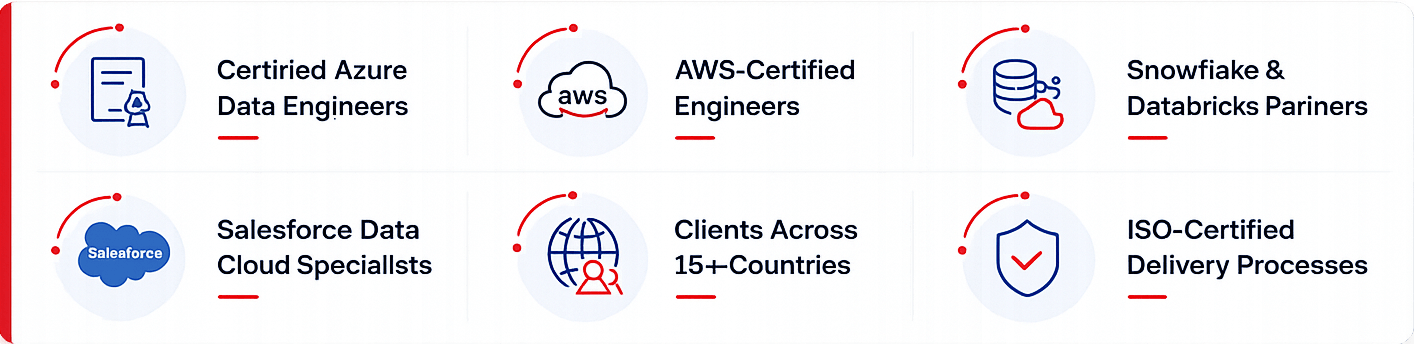
Our data engineers hold certifications from Microsoft Azure, Amazon AWS, Snowflake, Databricks, and Salesforce. We are not generalists who also do data — data engineering is a core practice for our team, with dedicated engineers who work exclusively on data infrastructure projects.
Full-lifecycle delivery, not just consulting
AwsQuality delivers the complete engagement — from discovery and architecture through to implementation, testing, deployment, and ongoing support. We do not hand over a design document and leave. Our engineers build and run what we design.
Technology-agnostic architecture
We are not tied to a single vendor or platform. Our recommendations are driven by what is best for your data volumes, existing infrastructure, team capability, and cost targets — not by partnership incentives. We work across Azure, AWS, GCP, Snowflake, Databricks, and open-source tooling.
Salesforce data engineering expertise
AwsQuality’s background as a leading Salesforce consulting partner gives us unique expertise in Salesforce data engineering — connecting Sales Cloud, Service Cloud, Marketing Cloud, and Salesforce Data Cloud with enterprise data platforms in ways that most data engineering companies cannot.
Transparent delivery with measurable outcomes
Every AwsQuality data engineering engagement defines success in measurable terms before work begins: pipeline reliability targets, data freshness SLAs, query performance benchmarks, cost reduction targets, and quality metrics. We measure and report against these throughout the engagement.
Scalable engagement models
AwsQuality works with organizations at every stage — from startups building their first data infrastructure to enterprises modernizing complex legacy stacks. We offer project-based engagements, dedicated team augmentation, and managed data engineering services.
Analytics and AI Readiness
We help create data foundations capable of supporting business intelligence, advanced analytics, machine learning, and emerging AI use cases.
Get Free Data Architecture Review
Industries We Serve
AwsQuality’s data engineering expertise spans organizations across:
- Financial Services and Banking — Regulatory reporting, fraud detection pipelines, risk data aggregation, and real-time transaction processing.
- Retail and E-Commerce — Customer behavior analytics, inventory optimization, demand forecasting, and omnichannel data unification.
- Healthcare and Life Sciences — Clinical data pipelines, patient data integration, operational reporting, and regulatory-compliant data governance.
- Manufacturing and Supply Chain — IoT data ingestion, predictive maintenance pipelines, supply chain visibility, and production analytics.
- Professional Services — Business intelligence infrastructure, client data platforms, and operational reporting pipelines.
- SaaS and Technology — Product analytics pipelines, usage data infrastructure, customer data platforms, and ML feature engineering.
- Public Sector — Secure, compliant data infrastructure with sovereignty and governance requirements.
When Should You Consider Data Engineering Services?
You may need professional data engineering services if:
- Business data is spread across disconnected systems
- Teams spend too much time manually preparing reports
- Different departments report conflicting numbers
- Existing data pipelines frequently fail
- Your data warehouse no longer meets business requirements
- Legacy ETL processes are difficult to maintain
- You are migrating data workloads to the cloud
- Data volumes are growing faster than your infrastructure can handle
- You need real-time or near-real-time analytics
- Your organization is preparing for AI or machine learning initiatives
- Your internal team needs additional data engineering expertise
- You want to modernize an existing data platform
If these challenges are familiar, the first step is understanding the current architecture and identifying where the greatest constraints exist.
Request a Data Engineering Assessment
Build a Stronger Foundation for Data, Analytics, and AI
Your organization may already have more data than ever before.
The question is whether that data is connected, reliable, accessible, and ready to create value.
AwsQuality provides data engineering services to help businesses move beyond fragmented systems and manual data processes. From data engineering consulting and data pipeline development to cloud platforms, data warehouses, data lakes, migration, modernization, Snowflake, and Databricks, we help build the infrastructure that turns data into a usable business asset.
Whether you are starting a new data initiative, modernizing an existing environment, or preparing your organization for AI, our team can help you define and build the right data foundation.
Ready to Modernize Your Data Infrastructure?
Request a free 30-minute data engineering consultation.
Our certified engineers will assess your current data landscape, identify your highest-priority opportunities, and outline a practical roadmap to production-grade data infrastructure.
Frequently Asked Questions
What are data engineering services?
Data engineering services help businesses collect, integrate, transform, store, process, and manage data so it can be reliably used for analytics, reporting, applications, machine learning, and AI. Services can include data pipeline development, ETL and ELT, data integration, data warehousing, data lakes, cloud data engineering, migration, and modernization.
What does a data engineering company do?
A data engineering company designs and builds the technical infrastructure that enables data to move reliably from source systems to destinations such as data warehouses, data lakes, analytics platforms, and AI environments. It may also provide consulting, architecture, integration, migration, modernization, and ongoing engineering support.
What is data engineering consulting?
Data engineering consulting helps organizations evaluate their current data environment and determine how to improve it. A data engineering consultant may assess architecture, pipelines, platforms, integrations, scalability, data quality, and modernization requirements before recommending a technical roadmap.
What is the difference between data engineering and data analytics?
Data engineering focuses on building the infrastructure and processes that collect, integrate, transform, and prepare data. Data analytics uses that prepared data to identify patterns, measure performance, answer business questions, and support decisions. Reliable analytics depends on strong data engineering.
What is a data pipeline?
A data pipeline is an automated process that moves data from one or more source systems to another destination while potentially validating, cleaning, transforming, or enriching the data along the way. Data pipelines can operate in batches or process information in real time.
What is the difference between ETL and ELT?
ETL stands for Extract, Transform, Load. Data is transformed before it is loaded into the target system. ELT stands for Extract, Load, Transform. Data is loaded first and transformed within the destination platform. The appropriate approach depends on the architecture, data platform, scale, performance requirements, and use case.
What are cloud data engineering services?
Cloud data engineering services focus on designing, building, migrating, and optimizing data platforms in cloud environments. They may include cloud data pipelines, data warehouses, data lakes, integration, ETL and ELT, streaming architectures, and data modernization.
What do data engineering services include?
Data engineering services include data pipeline development, data integration, ETL and ELT implementation, data warehouse and lakehouse development, cloud data engineering, data migration, data quality management, and pipeline monitoring. The exact scope depends on an organization’s data sources, infrastructure, and business objectives.
When should a business invest in data engineering services?
A business may need data engineering services when data is fragmented across systems, reporting depends on manual preparation, pipelines frequently fail, data quality is inconsistent, or existing infrastructure cannot support growing analytics requirements. Data engineering is also important when preparing a reliable foundation for machine learning and AI applications.
What is the difference between data engineering and data analytics?
Data engineering focuses on building and maintaining the systems that collect, transform, store, validate, and deliver data. Data analytics uses that data to identify patterns, answer business questions, create reports, and support decisions. The two disciplines work together, but they address different stages of the data lifecycle.
How do data engineers ensure data quality?
Data engineers can implement validation rules, schema checks, duplicate detection, record reconciliation, data freshness monitoring, and automated tests throughout the pipeline. Logging, lineage, and alerting also help teams identify and investigate issues when they occur.
Which technologies are used in data engineering?
Technology choices depend on workload requirements, existing infrastructure, scalability, security, and cost. Common technology categories include cloud platforms such as AWS, Microsoft Azure, and Google Cloud; warehouses such as Snowflake; lakehouse and processing platforms such as Databricks and Apache Spark; and orchestration, integration, and transformation tools appropriate to the architecture.
How long does a data engineering project take?
Project duration depends on the number and complexity of data sources, the condition of existing data, integration requirements, security constraints, and the scope of the solution. A focused pipeline implementation may require substantially less time than an enterprise data platform migration or modernization project. A requirements and architecture assessment helps establish a realistic delivery plan.
How can data engineering support AI initiatives?
Data engineering prepares data for AI applications through ingestion, transformation, validation, governance, and ongoing synchronization. Depending on the use case, this may include building curated datasets for machine learning, creating retrieval-ready data pipelines for retrieval-augmented generation (RAG), or integrating structured and unstructured data sources for AI workflows.
How can businesses control data engineering costs?
Businesses can manage data engineering costs by monitoring compute and storage consumption, optimizing queries and transformations, reducing unnecessary data movement, using incremental processing where appropriate, and matching resource allocation to workload demand. Regular monitoring helps identify inefficient pipelines and opportunities for improvement.
How do businesses choose a data engineering services company?
Businesses should evaluate a provider’s experience with relevant data architectures, cloud platforms, integration requirements, data quality, security, and production operations. Reviewing project examples, technical approaches, communication practices, and the provider’s ability to explain trade-offs can help determine whether its capabilities match the business’s needs.
What is a modern data stack?
A modern data stack is an ecosystem of technologies used to ingest, store, transform, orchestrate, monitor, and analyze data. It commonly uses cloud-native and specialized tools that can be combined based on an organization’s architecture and business requirements.
What is the difference between a data warehouse and a data lake?
A data warehouse typically stores structured and processed data optimized for reporting and analytics. A data lake can store larger volumes of structured, semi-structured, and unstructured data. The right architecture depends on the types of data being managed and how the organization intends to use it.
How does data engineering support AI?
Data engineering provides the pipelines, integrations, storage, transformations, and processing infrastructure required to make enterprise data available for AI systems. Reliable AI outcomes depend heavily on the accessibility, relevance, consistency, and quality of the underlying data.
Can you modernize an existing data platform?
Yes. Data modernization can involve migrating legacy infrastructure to the cloud, redesigning pipelines, replacing older ETL processes, modernizing data warehouses, implementing data lakes or lakehouse architectures, and improving scalability and maintainability.
What is data engineering outsourcing?
Data engineering outsourcing involves engaging an external company or engineering team to provide specialized data engineering expertise. Businesses may outsource a specific project, extend an internal team, access specialized skills, or obtain ongoing support for data platforms and pipelines.
How do I choose a data engineering consulting company?
Evaluate the company’s experience across data architecture, pipelines, cloud platforms, integration, warehousing, migration, and modernization. The right partner should also understand your business goals, existing technology ecosystem, scalability requirements, and future analytics or AI plans.
How long does a data engineering project take?
The timeline depends on the scope, number of data sources, complexity of the existing architecture, data quality, integration requirements, migration volume, technology stack, and desired business outcomes. A focused pipeline project may be significantly shorter than an enterprise-wide data platform modernization initiative.
How do I get started with a data engineering project?
Start by defining the business problem and assessing your current data environment. Identify your data sources, systems, bottlenecks, reporting or analytics requirements, and future goals. A data engineering assessment can help turn these findings into a prioritized architecture and implementation roadmap.