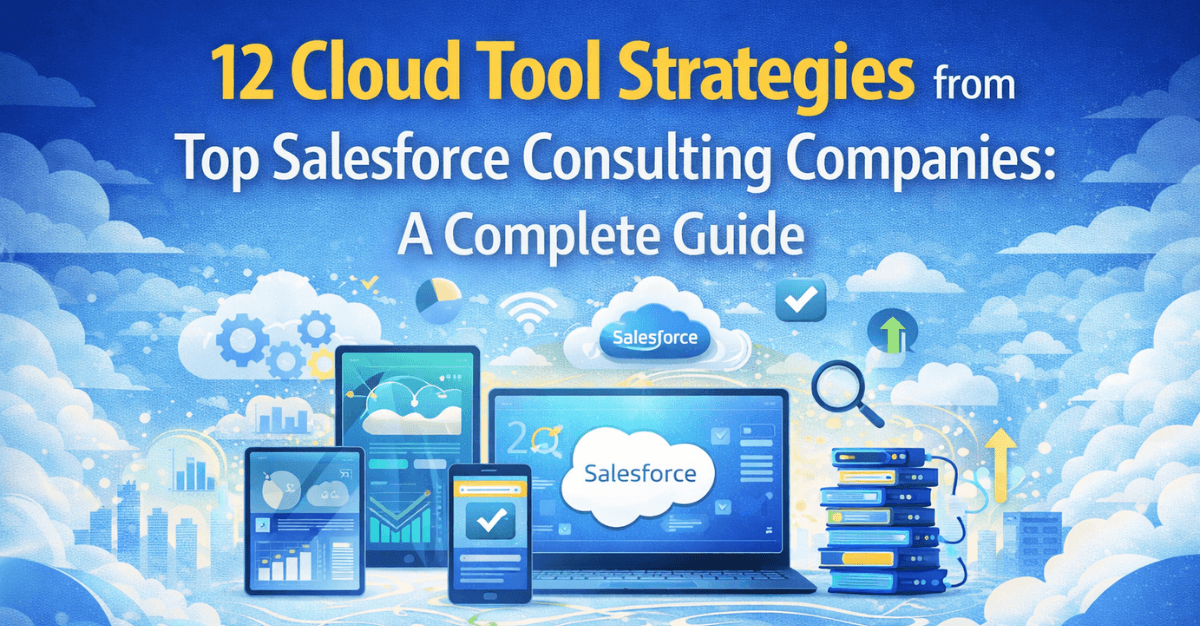
Among the leaders in cloud-based solutions, Salesforce stands out as a powerful platform that enables businesses to streamline processes, improve customer engagement, and drive growth. However, simply adopting cloud tools isn?t enough?the real value lies in how effectively they are used.
Top Salesforce consulting companies bring strategic expertise to help businesses maximize their cloud investments. In this guide, we?ll explore 12 proven cloud tool strategies used by these experts to help organizations unlock the full potential of Salesforce.
Why Cloud Tool Strategy Matters
Cloud tools are more than just software?they are enablers of transformation. A well-defined strategy ensures:
- Seamless operations across departments
- Better data visibility and decision-making
- Enhanced scalability and flexibility
- Improved customer experiences
Without a clear strategy, businesses risk underutilizing their cloud investments.
12 Cloud Tool Strategies from Salesforce Experts
1. Align Cloud Tools with Business Goals
Top consultants start by aligning cloud tools with business objectives. Whether the goal is increasing sales, improving customer service, or optimizing operations, every tool should serve a purpose.
Pro Tip:
Define KPIs early to measure success and ensure alignment.
2. Centralize Data for Better Insights
One of the biggest advantages of cloud platforms is centralized data. Salesforce consulting companies ensure all customer and business data is unified.
Benefits:
- Improved decision-making
- Real-time data access
- Reduced data silos
3. Leverage Automation for Efficiency
Automation is a key driver of productivity. Experts use Salesforce automation tools to streamline repetitive tasks such as:
- Lead management
- Email campaigns
- Workflow approvals
Result:
Teams can focus on high-value activities instead of manual tasks.
4. Integrate Multiple Systems Seamlessly
Businesses often use multiple tools, including ERP, marketing platforms, and analytics systems. Salesforce consultants ensure seamless integration between these systems.
Outcome:
- Unified workflows
- Consistent data across platforms
- Enhanced collaboration
5. Customize Solutions for Specific Needs
Every business is unique. Top consulting companies customize Salesforce solutions to match specific workflows, industries, and goals.
Examples:
- Custom dashboards
- Tailored workflows
- Industry-specific modules
6. Focus on User Experience and Adoption
Even the most advanced tools fail if users don?t adopt them. Consultants prioritize user-friendly interfaces and training programs.
Strategies:
- Simplified dashboards
- Role-based access
- Hands-on training
7. Implement Scalable Cloud Architectures
Scalability is a major advantage of cloud tools. Salesforce experts design systems that grow with your business.
Key Features:
- Flexible infrastructure
- Modular design
- Easy expansion
Read: Salesforce AI Agents – The Future of Enterprise Automation
8. Use Advanced Analytics and AI
Salesforce offers powerful analytics and AI capabilities. Consultants help businesses leverage these tools for:
- Predictive insights
- Customer behavior analysis
- Sales forecasting
Impact:
Data-driven decisions lead to better outcomes.
9. Strengthen Data Security and Compliance
Data security is a top priority. Salesforce consulting companies implement robust security measures, including:
- Role-based access controls
- Data encryption
- Compliance with regulations
10. Optimize Cloud Costs
Cloud tools can become expensive if not managed properly. Experts optimize costs by:
- Eliminating unused features
- Choosing the right licensing plans
- Monitoring usage
Result:
Maximum ROI with controlled spending.
Also read: Salesforce Consulting Partners vs. Salesforce Implementation Partners
11. Enable Continuous Integration and Updates
Salesforce regularly releases updates and new features. Consultants ensure systems stay up-to-date through:
- Continuous integration (CI/CD)
- Regular system audits
- Feature enhancements
12. Monitor Performance and Improve Continuously
Cloud strategy is not a one-time effort. Continuous monitoring and optimization are essential.
Approach:
- Track performance metrics
- Gather user feedback
- Implement improvements
How Salesforce Consulting Companies Add Value
Top Salesforce consulting companies do more than just implement tools?they act as strategic partners.
1. Expertise and Best Practices
Certified consultants bring deep knowledge and industry experience, ensuring efficient and effective implementation.
2. Faster Implementation
With proven methodologies, consultants reduce deployment time and avoid common pitfalls.
3. Custom Solutions
They tailor solutions to meet specific business needs, ensuring better outcomes.
4. Ongoing Support
From troubleshooting to optimization, consultants provide continuous support to keep systems running smoothly.
Also read: Apex vs Lightning Web Components – Choosing the Right Salesforce Development Approach
Common Mistakes to Avoid in Cloud Strategy
Even with powerful tools, businesses can make mistakes such as:
- Lack of clear objectives
- Poor data management
- Ignoring user training
- Overcomplicating workflows
Solution:
Work with experienced Salesforce consultants to avoid these pitfalls.
Best Practices for Cloud Tool Success
To maximize the benefits of cloud tools, follow these best practices:
- Start with a clear strategy
- Focus on user adoption
- Prioritize data quality
- Use automation wisely
- Continuously optimize systems
Future of Cloud Tools and Salesforce
The future of cloud technology is driven by:
- Artificial Intelligence (AI)
- Machine Learning (ML)
- Automation and hyper-personalization
Salesforce continues to innovate, making it essential for businesses to stay updated and adapt their strategies accordingly.
Chek out: Salesforce Not Delivering? Let Certified Salesforce Consulting Partners Fix It
Final Thoughts
Cloud tools have revolutionized the way businesses operate, and Salesforce stands at the forefront of this transformation. However, success depends not just on adopting these tools but on using them strategically.
By implementing these 12 cloud tool strategies, businesses can improve efficiency, enhance customer experiences, and achieve sustainable growth. Partnering with top Salesforce consulting companies ensures that you not only leverage the platform effectively but also stay ahead in a competitive market.
If you?re looking to maximize your cloud investment, adopting these expert strategies is the first step toward long-term success.
Frequently Asked Questions (FAQs)
1. What are cloud tools in Salesforce?
Cloud tools in Salesforce refer to applications and services hosted on the cloud that help businesses manage sales, marketing, customer service, and operations efficiently.
2. Why are cloud tool strategies important for businesses?
Cloud tool strategies ensure that businesses use their tools effectively, align them with goals, and maximize return on investment while improving efficiency and scalability.
3. How do Salesforce consulting companies help with cloud strategies?
Salesforce consulting companies provide expertise in implementation, customization, integration, and optimization of cloud tools to ensure maximum performance and business value.
4. What are the key benefits of using cloud tools?
Cloud tools offer benefits such as scalability, cost efficiency, real-time data access, improved collaboration, and enhanced customer experience.
5. How does automation improve cloud tool efficiency?
Automation reduces manual tasks, minimizes errors, and speeds up workflows, allowing teams to focus on more strategic and high-value activities.
6. Can cloud tools be customized for specific business needs?
Yes, cloud tools like Salesforce can be customized with tailored workflows, dashboards, and integrations to meet unique business requirements.
7. How do cloud tools improve data management?
Cloud tools centralize data, making it easier to access, analyze, and manage information in real-time, which improves decision-making and reduces data silos.
8. What role does AI play in Salesforce cloud tools?
AI helps analyze customer behavior, predict trends, automate processes, and provide actionable insights for better decision-making.
9. How can businesses ensure data security in cloud tools?
Businesses can implement security measures such as encryption, role-based access, regular audits, and compliance with industry regulations.
10. What are common challenges in cloud tool implementation?
Common challenges include lack of strategy, poor data quality, low user adoption, integration issues, and cost management.
11. How can businesses optimize cloud costs?
Cost optimization can be achieved by selecting the right plans, eliminating unused features, monitoring usage, and working with experienced consultants.
12. Why is continuous optimization important in cloud strategy?
Continuous optimization ensures that systems remain efficient, updated, and aligned with evolving business needs and technological advancements.
13. Is Salesforce suitable for small and medium businesses?
Yes, Salesforce offers scalable solutions that can be tailored to fit the needs and budgets of small and medium-sized businesses.
14. How do integrations enhance cloud tool performance?
Integrations connect different systems, enabling seamless data flow, improved workflows, and better collaboration across departments.
15. What is the future of cloud tools in business?
The future includes advancements in AI, automation, and personalization, making cloud tools even more powerful and essential for business growth.
 Bio
Bio