Enterprise organizations are constantly looking for ways to improve efficiency, reduce operational costs, and deliver better customer experiences. Over the past decade, automation has become a critical part of this transformation. Businesses have used workflow automation, robotic process automation (RPA), and AI-powered tools to streamline operations and eliminate repetitive tasks.
However, the next wave of enterprise automation is far more advanced. Instead of simply automating predefined workflows, modern systems are beginning to make decisions, analyze data, and perform tasks autonomously. This shift is being driven by AI agents.
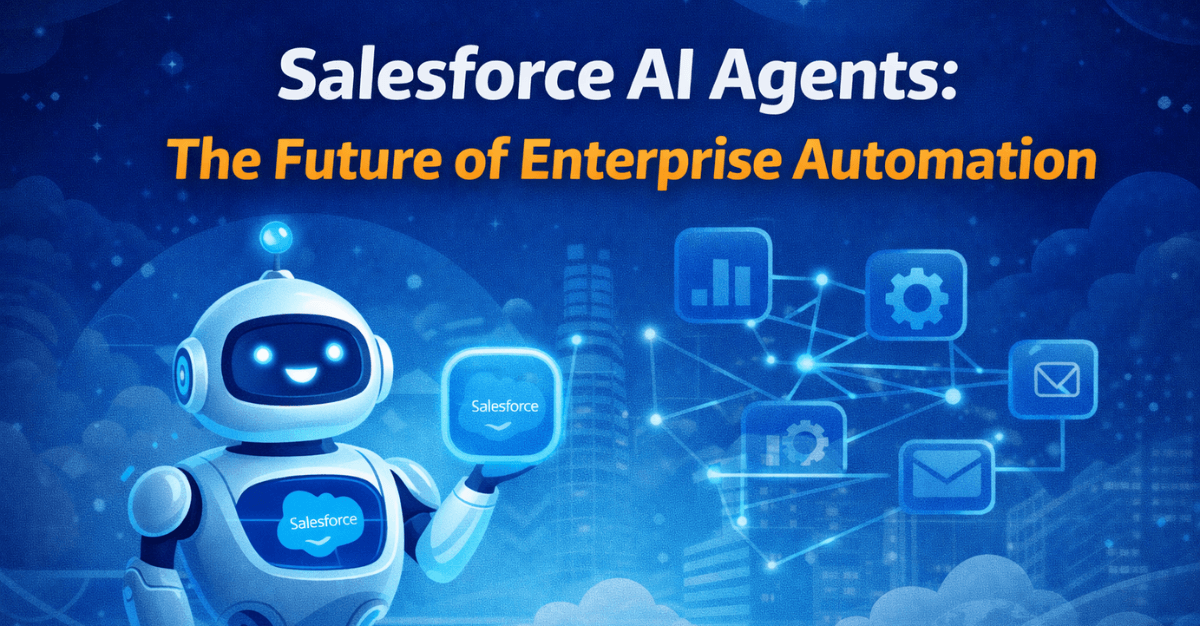
Within the Salesforce ecosystem, AI agents are emerging as a powerful tool for transforming how businesses operate. By combining artificial intelligence, automation, and real-time data, Salesforce AI agents enable organizations to automate complex processes while improving productivity and decision-making.
In this article, we explore what Salesforce AI agents are, how they work, their key use cases, and why they represent the future of enterprise automation.
Read: 12 Artificial Intelligence (AI) Solutions Every CTO Should Explore
What Are Salesforce AI Agents?
Salesforce AI agents are intelligent software systems that can perform tasks, analyze data, and make decisions within the Salesforce ecosystem. Unlike traditional automation tools that follow predefined rules, AI agents can learn from data, adapt to changing conditions, and perform complex workflows with minimal human intervention.
AI agents combine several advanced technologies, including:
- Artificial intelligence and machine learning
- Natural language processing (NLP)
- Predictive analytics
- Workflow automation
- Data integration across systems
These capabilities allow AI agents to perform tasks such as analyzing customer behavior, recommending actions, automating service responses, and assisting sales teams with decision-making.
Salesforce has been investing heavily in AI capabilities through technologies such as Einstein AI and AI-powered automation tools, which are designed to help businesses automate processes while maintaining accuracy and control.
Also read: Boosting Sales Team Productivity with Salesforce Automation
The Evolution of Automation in Salesforce
To understand the importance of AI agents, it is helpful to look at how automation within Salesforce has evolved.
Rule-Based Automation
Early Salesforce automation relied on rule-based tools such as workflows and process builders. These systems followed predefined conditions and triggered actions automatically.
For example:
- Sending an email when a lead is created
- Assigning tasks when an opportunity moves to a specific stage
While useful, rule-based automation lacked flexibility and intelligence.
Workflow Automation
The next phase introduced more advanced automation tools such as Salesforce Flow, allowing businesses to automate more complex workflows.
These tools improved automation capabilities but still required manual configuration and decision logic.
AI-Powered Automation
The newest phase introduces AI-driven automation where systems analyze patterns, generate insights, and recommend actions.
With Salesforce AI agents, automation becomes more intelligent and adaptive. Instead of simply following rules, AI agents can evaluate data and determine the best action based on context.
Check: Salesforce Service Cloud + AI — Next-Gen Customer Experience
Key Capabilities of Salesforce AI Agents
Salesforce AI agents offer a range of capabilities that extend beyond traditional automation.
Intelligent Task Automation
AI agents can automatically complete tasks that would normally require manual input. These tasks may include updating records, scheduling follow-ups, analyzing leads, or responding to common customer inquiries.
By automating routine activities, organizations can free up employees to focus on more strategic work.
Data Analysis and Insights
Modern enterprises generate vast amounts of data across multiple systems. AI agents can analyze this data in real time and provide actionable insights.
For example, AI agents can:
- Identify high-value leads
- Detect patterns in customer behavior
- Predict sales outcomes
- Recommend next best actions
These insights help teams make faster and more informed decisions.
Personalized Customer Interactions
AI agents can enhance customer engagement by delivering personalized interactions based on customer data.
For instance, AI-powered service agents can automatically provide tailored responses to customer inquiries, recommend relevant products, or escalate issues when necessary.
This improves both customer satisfaction and operational efficiency.
Cross-System Automation
Enterprise environments often include multiple systems such as CRM platforms, ERP systems, marketing tools, and customer support software.
Salesforce AI agents can integrate with these systems and automate workflows that span across multiple platforms.
This capability enables organizations to create seamless digital processes that connect sales, marketing, service, and operations.
Also check: Salesforce Workflow Automation - Powering Business Growth
Key Use Cases of Salesforce AI Agents
Salesforce AI agents can be applied across multiple departments within an organization.
Sales Automation
Sales teams often spend a significant amount of time on administrative tasks rather than selling.
AI agents can automate tasks such as:
- Lead scoring and qualification
- Opportunity prioritization
- Automated follow-up reminders
- Pipeline analysis
By reducing administrative workload, AI agents allow sales professionals to focus on building relationships and closing deals.
Customer Service Automation
Customer support teams must handle large volumes of inquiries while maintaining high service quality.
AI agents can assist support teams by:
- Responding to frequently asked questions
- Routing cases to the appropriate team
- Summarizing customer interactions
- Predicting potential service issues
These capabilities help reduce response times and improve overall customer experience.
Marketing Automation
Marketing teams rely heavily on data to design and optimize campaigns.
AI agents can analyze customer behavior and automate marketing actions such as:
- Audience segmentation
- Campaign personalization
- Lead nurturing workflows
- Performance analysis
This enables marketing teams to deliver more targeted and effective campaigns.
Business Operations
AI agents can also streamline internal operations by automating administrative workflows and data management tasks.
For example, organizations can use AI agents to:
- Generate reports automatically
- Monitor business performance metrics
- Trigger alerts when anomalies occur
- Optimize operational workflows
These capabilities improve operational efficiency across the organization.
Also check: How to Measure the Success of Your Salesforce Projects
Benefits of Salesforce AI Agents for Enterprises
The adoption of AI agents provides several strategic advantages for enterprises.
Increased Productivity
By automating repetitive tasks, AI agents allow employees to focus on higher-value work that requires creativity and strategic thinking.
Faster Decision-Making
AI agents analyze data in real time and provide recommendations that help teams make faster and more informed decisions.
Improved Customer Experience
Personalized interactions and faster response times lead to better customer experiences and stronger customer relationships.
Scalability
As organizations grow, AI agents can handle increasing workloads without requiring proportional increases in staffing.
Better Data Utilization
AI agents help organizations unlock the full value of their data by identifying patterns and insights that may otherwise go unnoticed.
Read: 18 Reasons to Hire a Certified Salesforce Developer for Your Business
Challenges of Implementing Salesforce AI Agents
While AI agents offer significant benefits, organizations must also address several challenges when implementing these technologies.
Data Quality Issues
AI systems rely heavily on accurate data. Poor data quality can lead to inaccurate predictions and ineffective automation.
Organizations must ensure that their data is clean, consistent, and well-structured.
Integration Complexity
Enterprise systems often include multiple applications that must work together. Integrating AI agents across these systems can be complex without proper architecture and integration planning.
Change Management
Adopting AI-driven automation requires employees to adapt to new workflows and tools.
Organizations must invest in training and change management to ensure successful adoption.
Best Practices for Implementing Salesforce AI Agents
For CTOs and IT leaders considering AI agents, several best practices can help ensure successful implementation.
Start with Clear Use Cases
Rather than attempting to automate everything at once, organizations should begin with well-defined use cases where AI agents can deliver immediate value.
Ensure Strong Data Governance
High-quality data is essential for effective AI automation. Implementing strong data governance practices helps maintain reliable data sources.
Focus on Integration
AI agents should operate within a connected ecosystem. Integrating Salesforce with other enterprise systems ensures that AI agents have access to the information they need.
Monitor and Optimize
AI systems should be continuously monitored and refined to improve performance over time.
The Future of Salesforce AI Agents
The role of AI agents in enterprise automation is expected to grow significantly in the coming years.
Future developments may include:
- More advanced conversational AI capabilities
- Autonomous decision-making systems
- Deeper integration with enterprise platforms
- Enhanced predictive analytics
As AI technology continues to evolve, Salesforce AI agents will become increasingly capable of handling complex business processes.
For organizations looking to remain competitive in a rapidly changing digital landscape, adopting AI-driven automation will be a key strategic priority.
Check out: 12 Powerful Salesforce Facts and Strategies
Conclusion
Salesforce AI agents represent the next generation of enterprise automation. By combining artificial intelligence, real-time data analysis, and automated workflows, these intelligent systems enable organizations to streamline operations and deliver better customer experiences.
For CTOs and IT leaders, AI agents offer an opportunity to transform Salesforce from a traditional CRM platform into a powerful automation engine that drives productivity, innovation, and growth.
As businesses continue to embrace digital transformation, Salesforce AI agents will play an increasingly important role in shaping the future of enterprise technology.
Frequently Asked Questions (FAQs)
1. How do Salesforce AI agents improve enterprise automation?
Salesforce AI agents automate repetitive tasks, analyze customer data, provide recommendations, and streamline workflows, helping organizations improve efficiency and productivity.
2. What are some common use cases of Salesforce AI agents?
Common use cases include lead scoring, automated customer support responses, sales forecasting, marketing campaign optimization, and workflow automation.
3. How do Salesforce AI agents support sales teams?
AI agents help sales teams prioritize leads, recommend next best actions, automate follow-ups, and provide insights into customer behavior and sales opportunities.
4. Can Salesforce AI agents improve customer service operations?
Yes. AI agents can automatically respond to common customer inquiries, route support cases to the right teams, and analyze customer sentiment to improve service quality.
5. What technologies power Salesforce AI agents?
Salesforce AI agents are powered by technologies such as machine learning, natural language processing (NLP), predictive analytics, and automation tools like Salesforce Einstein AI.
6. Are Salesforce AI agents secure for enterprise use?
Yes. Salesforce AI solutions follow strict security standards, including data encryption, authentication controls, and compliance with enterprise security policies.
7. How do businesses implement Salesforce AI agents?
Organizations typically implement Salesforce AI agents by integrating AI tools within Salesforce, defining automation workflows, and ensuring high-quality data for accurate insights.
8. What are the benefits of using AI agents in Salesforce?
Benefits include improved productivity, faster decision-making, enhanced customer experiences, scalable automation, and better use of organizational data.
9. Are Salesforce AI agents the future of CRM automation?
Yes. As AI technology evolves, Salesforce AI agents are expected to play a major role in automating business processes, improving customer engagement, and supporting data-driven decision-making.
 Bio
Bio