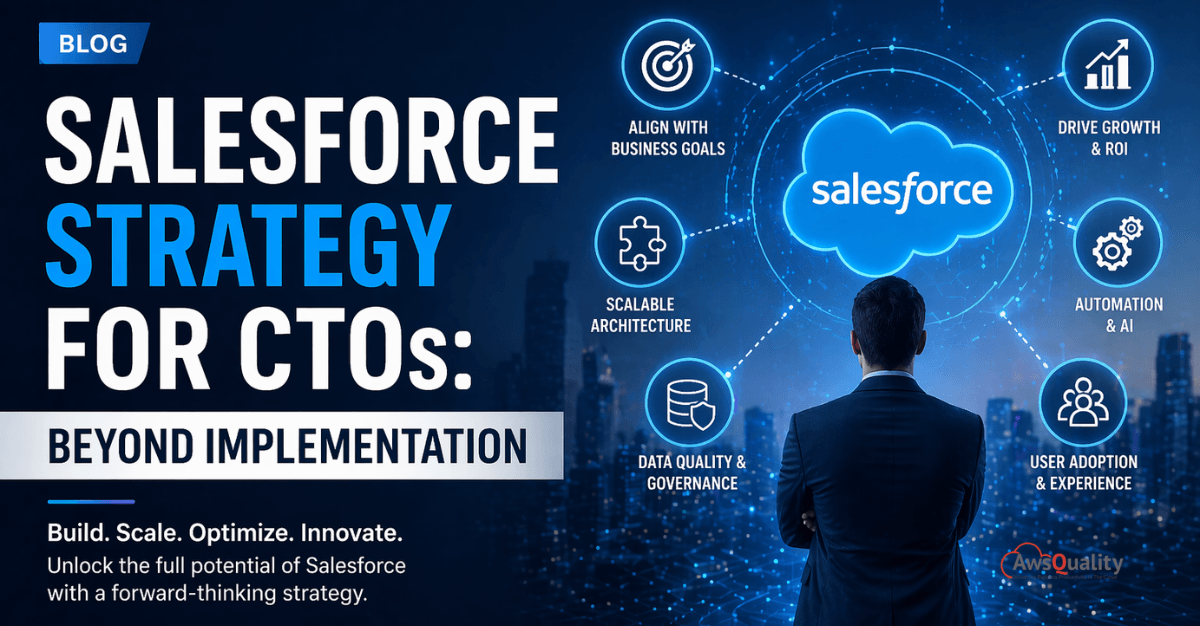
In many organizations, Salesforce implementation is treated as a milestone—a project with a defined beginning and end. Once the system is deployed, leadership often assumes the work is complete. For CTOs, however, this mindset can be limiting. The real value of Salesforce lies not in its implementation, but in how strategically it is leveraged over time.
Salesforce is not just a CRM platform; it is an evolving ecosystem that touches sales, service, marketing, operations, and increasingly, AI-driven decision-making. For CTOs, the challenge is to move beyond implementation and build a long-term strategy that aligns Salesforce with business growth, operational efficiency, and innovation.
Moving from Implementation to Strategy
Implementation focuses on configuring Salesforce to meet current requirements—setting up objects, workflows, integrations, and dashboards. While this is important, it only addresses immediate needs. A strategic approach, on the other hand, considers how Salesforce will evolve alongside the business.
CTOs must ask critical questions:
- How will Salesforce support business growth over the next 3–5 years?
- Can the current architecture scale with increasing data, users, and complexity?
- How will new technologies like AI and automation be integrated?
A well-defined strategy ensures that Salesforce becomes a long-term asset rather than a short-term solution.
Read: 5 Ways Salesforce Can Improve Your Customer Experience
Aligning Salesforce with Business Objectives
One of the most common pitfalls is treating Salesforce as a technical system rather than a business enabler. CTOs must ensure that Salesforce initiatives are directly aligned with organizational goals.
For example, if the business aims to improve customer retention, Salesforce should be optimized to provide better customer insights, automate follow-ups, and enhance service workflows. If revenue growth is the priority, the focus should be on pipeline visibility, lead management, and sales forecasting.
This alignment requires close collaboration between technical teams and business stakeholders. Salesforce strategy should not be developed in isolation—it must reflect the needs of sales leaders, marketing teams, customer service managers, and executives.
Building a Scalable Architecture
As organizations grow, their Salesforce environments often become complex and difficult to manage. What starts as a simple implementation can evolve into a system filled with redundant fields, overlapping automations, and inconsistent data structures.
CTOs play a crucial role in preventing this by focusing on scalable architecture. This includes:
- Designing clean and flexible data models
- Avoiding unnecessary customizations
- Standardizing processes across teams
Ensuring proper documentation
A scalable architecture reduces technical debt and makes it easier to introduce new features without disrupting existing workflows.
Read: How to Build AI-Powered Workflows in Salesforce?
Leveraging Integration as a Strategic Advantage
Salesforce rarely operates in isolation. It needs to integrate with ERP systems, marketing platforms, analytics tools, and other business applications. These integrations are not just technical requirements—they are strategic enablers.
When systems are properly integrated, data flows seamlessly across the organization. This eliminates manual work, reduces errors, and provides a unified view of customers and operations.
CTOs should focus on building a robust integration strategy that ensures reliability, scalability, and maintainability. This may involve using APIs, middleware solutions, or integration platforms depending on the complexity of the ecosystem.
Driving Adoption and User Experience
Even the most well-designed Salesforce system will fail if users do not adopt it. Low adoption is often a symptom of poor user experience, not user resistance.
CTOs must prioritize usability by ensuring that Salesforce aligns with how teams actually work. This involves simplifying interfaces, removing unnecessary fields, and automating repetitive tasks.
Training and change management are equally important. Users need to understand not just how to use Salesforce, but why it benefits them. When employees see value in the system, adoption improves naturally.
Check out: How to Transform Your Sales Team Performance with a Salesforce Consulting Partner?
Harnessing AI and Automation
Salesforce has significantly expanded its capabilities in AI and automation. Features like predictive analytics, intelligent workflows, and AI-driven insights can transform how businesses operate.
For CTOs, the key is to adopt these capabilities strategically rather than reactively. Instead of implementing AI for the sake of innovation, focus on areas where it can deliver measurable value—such as lead scoring, customer segmentation, or service automation.
Automation can also reduce operational overhead by streamlining repetitive processes. However, it must be implemented carefully to avoid creating confusion or unintended consequences.
Ensuring Data Quality and Governance
Data is the foundation of Salesforce. Without accurate and reliable data, even the most advanced features become ineffective.
CTOs must establish strong data governance practices to maintain data quality over time. This includes:
- Defining data standards and naming conventions
- Implementing validation rules and controls
- Regularly auditing data for inconsistencies
- Managing duplicate records
Good data governance not only improves decision-making but also enhances trust in the system.
Managing Cost and Maximizing ROI
Salesforce is a significant investment, and CTOs are responsible for ensuring that it delivers value. This requires ongoing evaluation of costs and benefits.
Organizations often accumulate unused licenses, redundant tools, or underutilized features. Regular audits can help identify these inefficiencies and optimize spending.
At the same time, CTOs should focus on initiatives that drive measurable outcomes—such as increased revenue, improved efficiency, or better customer experience. A strategic approach ensures that Salesforce investments translate into tangible business results.
Also check: Salesforce Integration Strategy for Modern Enterprises
Preparing for Continuous Evolution
Technology and business needs are constantly changing. A static Salesforce setup quickly becomes outdated.
CTOs must adopt a mindset of continuous improvement. This involves:
- Regularly reviewing system performance
- Staying updated with new Salesforce features
- Gathering feedback from users
- Iterating on processes and configurations
By treating Salesforce as an evolving platform, organizations can stay agile and competitive.
Conclusion
For CTOs, Salesforce strategy goes far beyond implementation. It requires a holistic approach that integrates technology, business objectives, user experience, and long-term scalability.
By focusing on alignment, architecture, integration, adoption, and continuous improvement, CTOs can transform Salesforce from a simple CRM into a powerful driver of growth and innovation.
The organizations that succeed are not those that implement Salesforce — they are the ones that continuously refine and evolve their strategy to unlock its full potential.
Frequently Asked Questions
1. What is a Salesforce strategy for CTOs?
A Salesforce strategy for CTOs focuses on aligning the platform with business goals, scalability, and long-term growth rather than just implementation.
2. Why is Salesforce strategy important beyond implementation?
Because implementation only addresses current needs, while strategy ensures long-term value, efficiency, and adaptability.
3.How can CTOs improve Salesforce adoption?
By focusing on user experience, simplifying workflows, and providing proper training and support.
4. What role does AI play in Salesforce strategy?
AI enhances decision-making, automates processes, and improves customer experience when implemented strategically.
5. How can Salesforce be scaled effectively?
Through clean architecture, proper data management, and flexible system design.
6. What are common challenges in Salesforce strategy?
Low adoption, poor data quality, lack of integration, and increasing system complexity.
7. How often should Salesforce strategy be reviewed?
It should be reviewed regularly, ideally every quarter, to adapt to changing business needs.
 Bio
Bio